
The UFV-Pfizer Chair in Person-Centered Medicine and Humanization of Care has published the report “Improving Clinical Practices Together at Madrid’s University Hospitals: A Dialogue Among Students, Healthcare Administrators, and Universities in the Community of Madrid.” The project included the participation of SEDISA—the Spanish Society of Healthcare Executives—to provide the healthcare management perspective.
This white paper analyzes the experiences of medical students during their clinical rotations and offers recommendations for improving the quality of education at university hospitals.
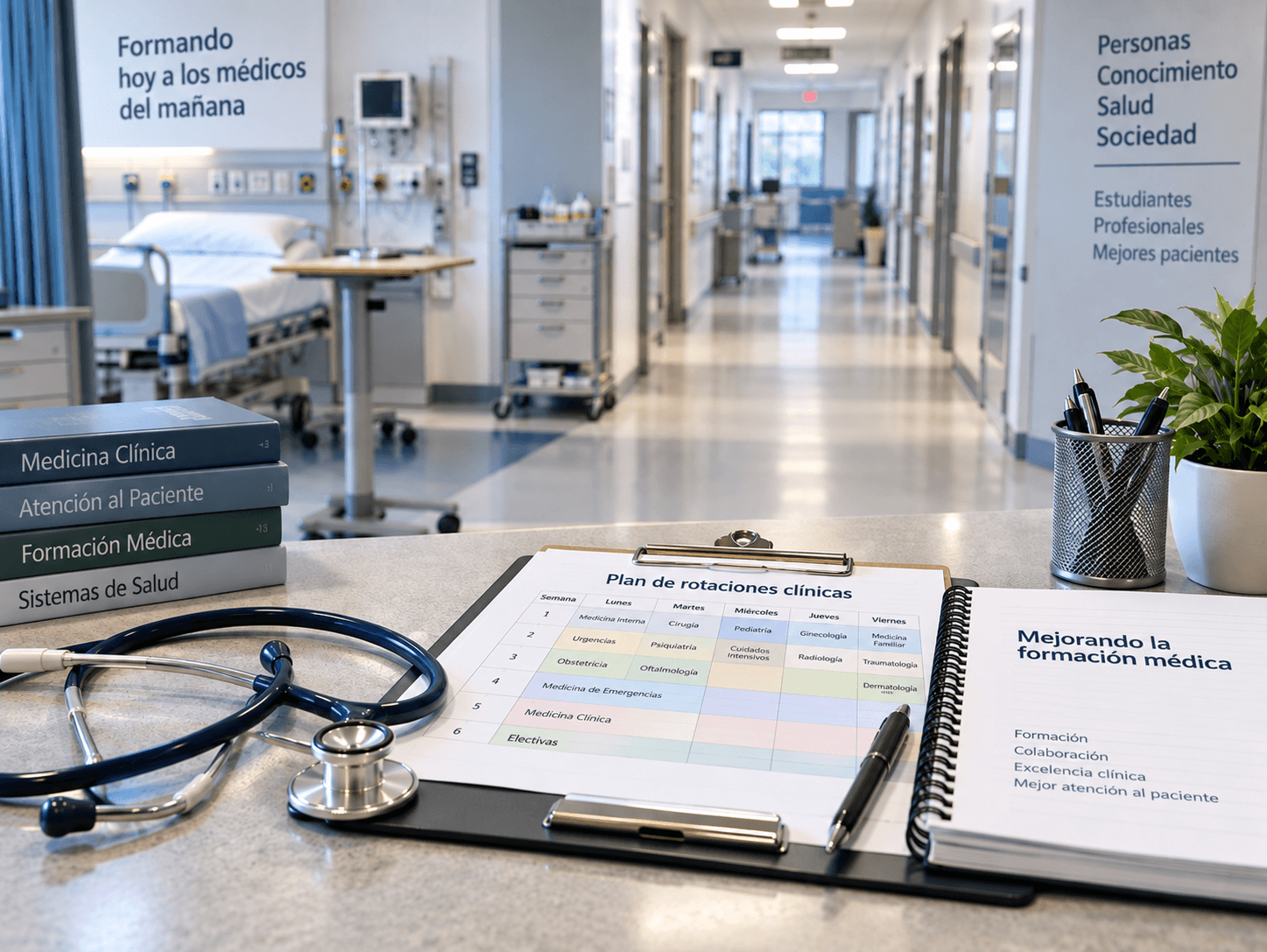
SEDISA, for its part, describes its participation in the project as follows: “For SEDISA, participating in this project means contributing to a necessary reflection on how clinical practices should be organized and supported in university hospitals. The training of future doctors depends not only on academic knowledge, but also on the quality of the clinical settings in which they learn, on coordination between the university and the hospital, and on the healthcare system’s ability to offer rigorous, human-centered training experiences that are aligned with patients’ real needs,” explains José Soto Bonel, president of SEDISA.
The report identifies a key finding: the quality of clinical practice depends largely on whether the student feels integrated into the health care team, understands their role, is able to participate progressively, and receives guidance from health care professionals. Genuine integration into the team and the professional’s teaching attitude appear in all eight nominal groups analyzed, reflecting a very high degree of consistency in students’ perceptions.
A project that has involved students from all the medical schools in Madrid
The project was developed based on a qualitative study involving 63 medical students from eight universities in Madrid, both public and private: the University of Alcalá, the Autonomous University of Madrid, the Complutense University of Madrid, Rey Juan Carlos University, Alfonso X the Wise University, the European University of Madrid, Francisco de Vitoria University, and CEU San Pablo University. The document does not evaluate specific institutions, but rather identifies common patterns, best practices, and opportunities for improving the system.
“This project stems from a shared conviction: clinical rotations are a crucial part of training future doctors. During these placements, students don’t just learn medicine; they learn to be there for the patient, to be part of a team, to make responsible decisions, and to understand the human dimension of the profession,” says Fernando Caballero Martínez, dean of the UFV School of Medicine.
Coordination, Clear Objectives, and a Culture of Teaching
The study emphasizes that clinical rotations are the setting where students begin to “feel like doctors” as they come into contact with the realities of patient care, clinical teams, patients, and the dynamics of the healthcare system. This experience has a direct impact on their motivation, professional confidence, choice of specialty, and development of a medical vocation.
Among the main barriers identified are the lack of coordination between the university and the hospital, mentioned in 8 of the 8 focus groups; an overload of students in certain departments, present in 7 of the 8 groups; variability in the quality of teaching, also identified in 7 of the 8 groups; logistical problems; the absence of clear objectives for each rotation; and an evaluation perceived as lacking transparency or consistency.
The report notes that many improvements do not require large investments, but rather organization, coordination, and explicit recognition of the teaching role of healthcare professionals.
Proposals for Improving Hospital Practices
The document proposes measures in five areas: organization, teaching, clinical rotation structure, assessment, and the university hospital’s strategic vision. These include strengthening coordination between universities and hospitals, better planning rotations, designating a clear mentor or supervisor for each department, establishing minimum educational objectives, improving the orientation process for students on their first day, adjusting student-to-staff ratios, using common assessment rubrics, and recognizing the teaching contributions of healthcare professionals.
“One of the report’s most important conclusions is that students want to participate, not just observe. Progressive, supervised autonomy is key to ensuring that clinical rotations are truly educational. The challenge lies in ensuring that this participation takes place safely, with clear objectives, and with faculty guidance,” notes Francisco J. Campos Lucas, associate dean for Graduate Studies and Institutional Relations at the UFV School of Medicine.
The preliminary results of the study were discussed at a workshop held at the Official College of Physicians of Madrid, which brought together 87 attendees, including student representatives, academic leaders, professors, clinical instructors, and administrators from university hospitals. During the discussion, a high degree of agreement was observed between the students’ perspective and that of academic leaders and healthcare administrators.
The report concludes that the Community of Madrid, with ten medical schools in operation, more than 2,000 new students admitted annually, and an extensive network of public and private university hospitals, has a unique opportunity to lead a coordinated improvement in clinical practices.