A study by Francisco de Vitoria University and the Cardenal Cisneros University Center shows that the “ programme ” program at La Quinta Cocina, managed by CESAL, is associated with improvements in autonomy, social support, self-concept, and a sense of purpose.
The study draws on an everyday reality for many young migrants: finding a job is important, but it’s not enough when adulthood brings with it unresolved paperwork, educational credentials that are difficult to validate, and few adults nearby to turn to for help.
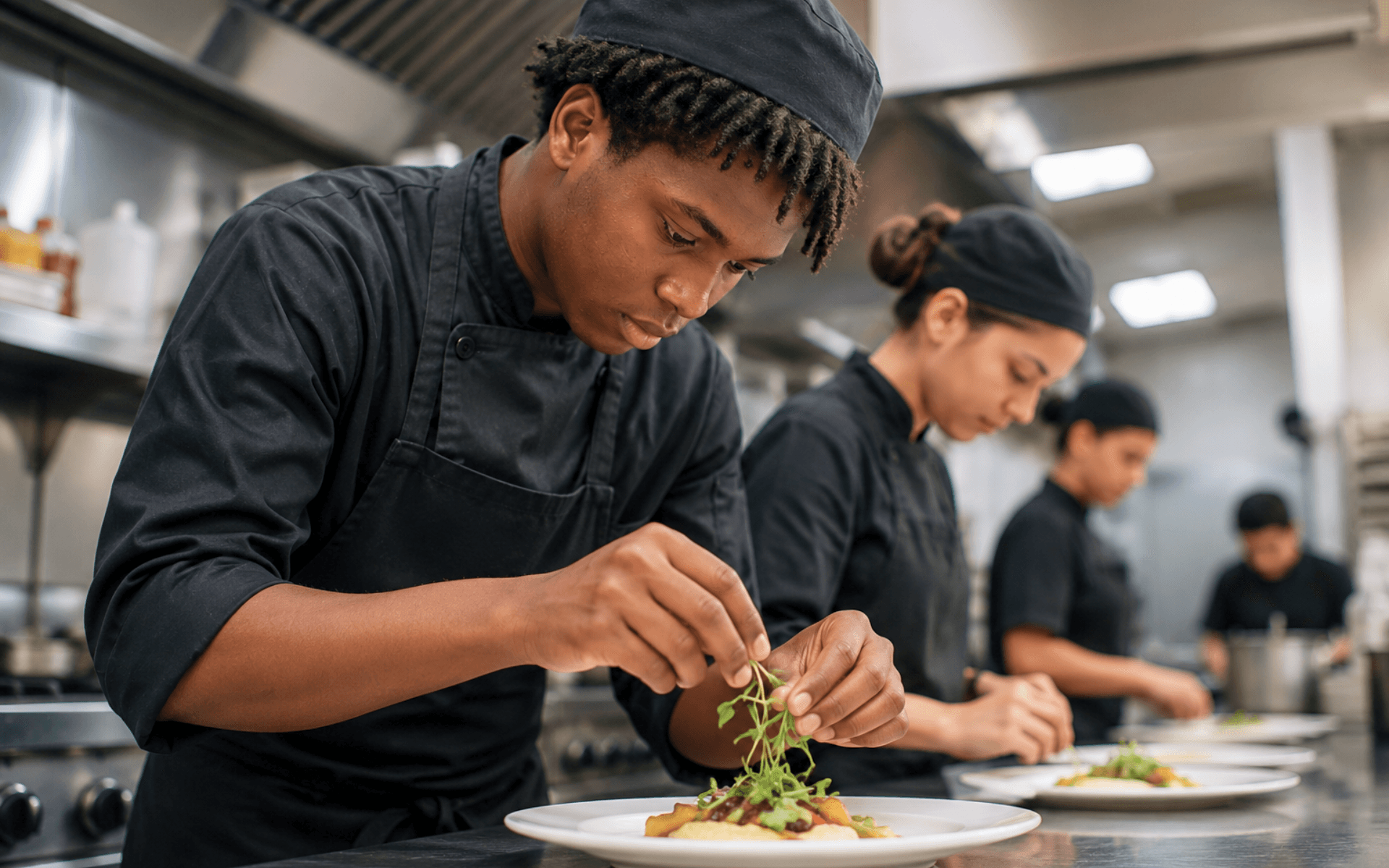
La Quinta Cocina, sponsored by the Madrid City Council and run by CESAL, uses gastronomy as an educational tool. Over the course of six months, it combines training in the hospitality industry, professional internships, and psychosocial support. The underlying question is: what happens when a cooking course also becomes a space for learning responsibility, building confidence, forming bonds, and shaping the future?
Four Improvements Upon Completing "La Quinta Cocina"
The study evaluated 102 young migrants between the ages of 18 and 25 enrolled in La Quinta Cocina. After completing the programme, the participants showed statistically significant improvement in four dimensions closely related to independent living: autonomy for the transition to adulthood, sense of purpose, perceived social support, and self-concept.
According to Álvaro Fernández-Moreno, a researcher with the Education, Design, and Psychosocial Intervention Research Group at UFV, these young people’s autonomy does not depend solely on learning a trade. It also requires social support, confidence in their own abilities, and a clear sense of direction for the future. “Autonomy also requires connections and purpose,” he explains.
The research thus shines a light on an idea that is rarely discussed in public debate: social and labor integration requires feeling capable of** holding down a job, interacting with others, making decisions, and envisioning a possible future**.
Learning a trade helps open the first door; support helps turn that opportunity into a sustainable venture.
When Adulthood Arrives Without a Safety Net
Nearly half of the participants—47.1%—had been unaccompanied migrant children. In addition, 35.3% did not have legal status in Spain, 26.3% had not completed compulsory education, and 20.2% held foreign credentials that were not officially recognized. These figures illustrate a cumulative vulnerability: immigration status, education, housing, employment, and a lack of adult support.
For Herminia Cid García, co-author of the study and a researcher at Cardenal Cisneros University, educational support takes on meaning precisely at the point where education intersects with everyday life.
From this perspective, training can become an experience of personal growth, in addition to preparing individuals for employment. “The risk is reaching adulthood without a sufficient support network,” says the researcher.
The authors found no statistically significant differences between those who had been unaccompanied migrant children and those who had not. Both groups followed a similar trajectory.
The research team believes this result can be explained by the fact that the sample consisted of at-risk youth, many of whom were referred by social services, with shared needs that went beyond their specific migration trajectories.
Craft, Connections, and a Sense of the Future
The Quinta Cocina program lasts six months: three months of theoretical and practical training in the hospitality industry and three months of professional internships at restaurants and companies in the sector.
Young people learn culinary techniques, food safety, nutrition, kitchen management, and front-of-house service, as well as communication, teamwork, responsibility, and emotional management.
Cooking serves as an educational and social tool. The “ programme ” is described in the article as a humanistic intervention because it recognizes the dignity and potential of each participant and does not reduce their journey to merely obtaining a professional qualification. The kitchen becomes a realistic and demanding environment where habits are cultivated, rules are followed, and participants learn to interact with others.
From a methodological perspective, Román D. Moreno-Fernández, director of the UFV Institute of Neuroscience and Applied Social Psychology, highlights the study’s focus on how psychological and social variables are related. “The data suggest that **a sense of purpose, social support, and self-concept work together to enhance autonomy during the transition to adulthood,” **he states.
More Support for Those Who Start With Less
One of the most interesting findings emerges when we look at how the young people were doing at the start of the “ programme ” study. Those who had the most difficulty seeing a clear path in their lives also perceived less social support and exhibited a more fragile self-image.
After the intervention, that combination was associated with greater improvements in autonomy, suggesting that La Quinta Cocina could be especially helpful for those who start out with fewer social connections and less self-confidence.
Support seems to carry more weight when basic resources are lacking. David Roncero, co-author of the study in the area of research and methodology, emphasizes the caution required by the study’s design itself: the results are encouraging, but they need to be confirmed by studies that include a control group and long-term follow-up to determine whether the changes persist over time.
That nuance is important. The study does not allow us to conclude that all improvements are due solely to the programme, but it does offer a valuable clue for better evaluating inclusion policies.
For young people from vulnerable backgrounds, it is not enough to simply measure whether they enter the labor market; it is also important to know whether they gain autonomy, support, confidence, and the ability to sustain an adult life.
The research offers a useful insight for social organizations, government agencies, and universities: social and labor inclusion gains greater depth when it views young people as individuals, not just as future workers.
For those who enter adulthood with too many burdens, learning a trade can be a starting point; feeling supported, capable, and having a viable plan is what helps keep them on track.