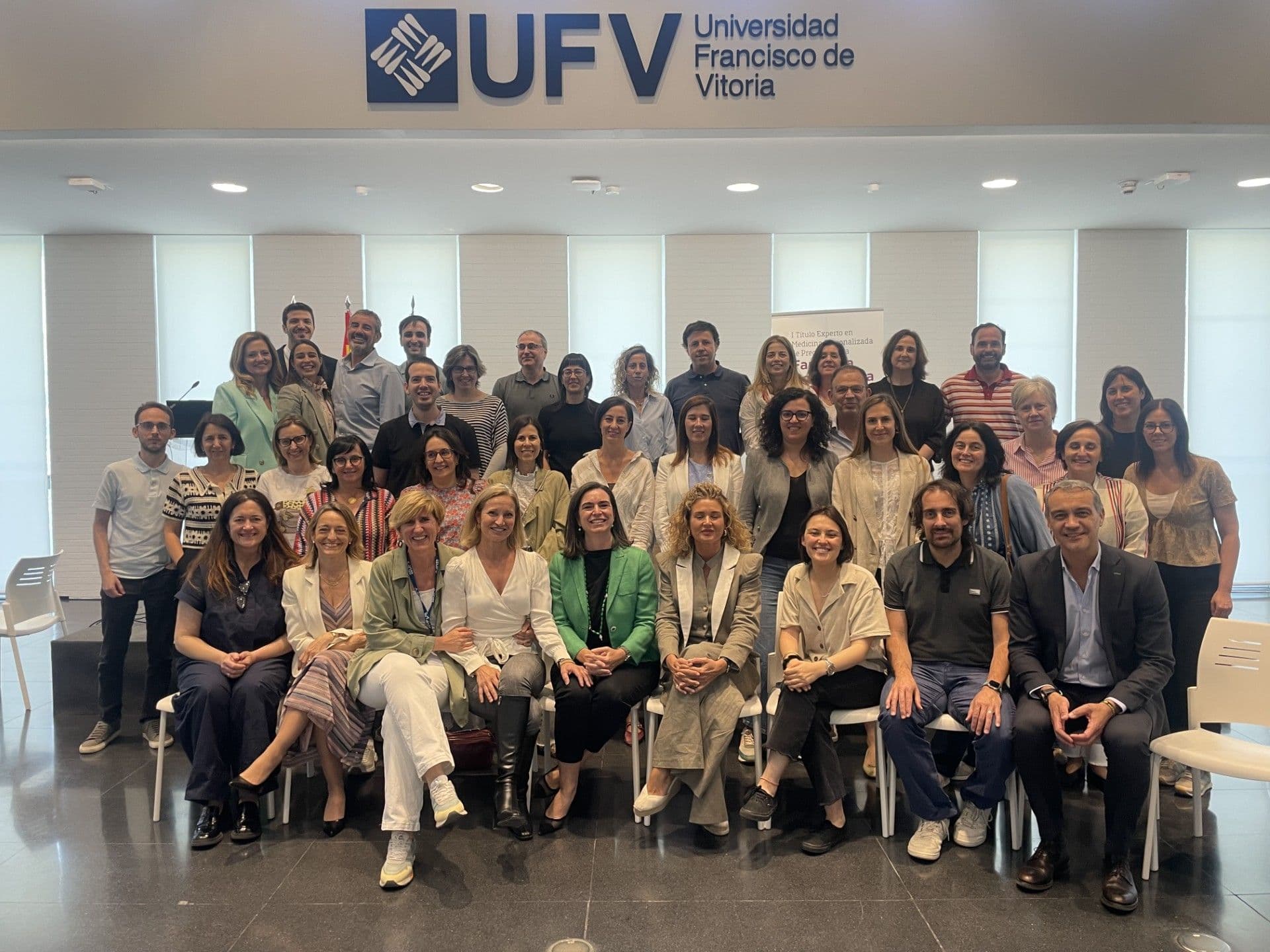
The Francisco de Vitoria University, the Spanish Society of Hospital Pharmacy (SEFH), and AstraZeneca have concluded the first edition of the Expert Certificate in Personalized Precision Medicine for Hospital Pharmacy, a specialized training program designed to equip hospital pharmacists—who play an increasingly strategic and cross-functional role in improving patient care—with the necessary skills.
The programme to the paradigm shift currently taking place in healthcare, which is increasingly oriented toward preventive, predictive, personalized, and patient-centered models. In this context, personalized precision medicine is transforming the way we diagnose, treat, and support patients by enabling a therapeutic approach that is more closely tailored to each person’s biological and clinical characteristics.
Participants had the opportunity to work on various complex clinical cases, which were discussed by a committee composed of oncologists, pathologists, and pharmacists who are experts in personalized medicine.
The importance of this training is part of a trend widely supported by scientific evidence. According to a European study published in the scientific journal The Lancet, prescribing guided by pharmacogenomic information reduces clinically relevant adverse reactions by 30% compared to standard care. Likewise, the Spanish Society of Medical Oncology notes that advances in personalized medicine allow for therapeutic decisions based on the genetic and molecular characteristics of each tumor—a development closely linked to the identification of new biomarkers.
The Expert Certificate program was developed by Francisco de Vitoria University in collaboration with the SEFH and with sponsorship from AstraZeneca, with the goal of equipping hospital pharmacists with advanced skills in genomic medicine and precision medicine. The initiative also strengthens the role of these professionals within multidisciplinary teams and advanced clinical decision-making structures.
The UFV provides training in new skills to address the challenges of the new clinical environment
During the programme, participants worked on various complex clinical cases, which were subsequently presented and discussed in a Molecular Tumor Board setting, comprising oncologists, pathologists, and pharmacists who are experts in personalized medicine.
The activity simulated the actual operations of the molecular committees currently in place at numerous healthcare centers, where different specialists collaborate on the interpretation of genomic and molecular information to guide personalized treatment decisions.
This approach allowed students to gain exposure to real-world scenarios and gain a deeper understanding of the value of collaborative work in providing comprehensive patient care. Practical training, linked to pioneering care models, also helps improve the employability of healthcare professionals and meet the current and future needs of the healthcare system.
The Hospital Pharmacist: A Key Role in Precision Medicine
The Expert Certification has been designed to enable hospital pharmacists to integrate into the new care models associated with personalized therapy. Key competencies include the interpretation of genetic and genomic reports, the efficient selection of molecular tests, pharmacological optimization based on biomarkers and pharmacogenetics, as well as participation in molecular committees and advanced clinical decision-making settings.
In addition, the programme the impact of new tools based on artificial intelligence and machine learning applied to the clinical follow-up and monitoring of patients, reinforcing the strategic role of the hospital pharmacist in the medicine of the future.
The opening session featured Cecilia Martínez Fernández-Llamazares, president of the SEFH; Julián Romero, director of Bachelor's Degree Pharmacy at UFV; and the program's scientific directors, Dr. Icíar Martínez López and Dr. Beatriz Bellosillo.
A programme leading scientific direction
The scientific direction of the degree program was led by Dr. Icíar Martínez López, coordinator of the Balearic Islands Genetics and Genomics Unit (GENIB), and Dr. Beatriz Bellosillo, head of the Molecular Laboratory in the Department of Pathology at Hospital del Mar and associate professor at Pompeu Fabra University.
“Personalized precision medicine represents one of the greatest paradigm shifts in today’s healthcare system and requires us to rethink how we train healthcare professionals. At UFV, we want to promote programs connected to real-world clinical practice, scientific innovation, and the future needs of the healthcare system,” said Julián Romero, director of UFV’s Bachelor's Degree Pharmacy.
Romero also emphasized that “hospital pharmacists are called upon to play an increasingly strategic role in multidisciplinary teams focused on personalise and improving patient care.”
Universities, scientific societies, and the healthcare industry working together to drive innovation
The closing of this first edition solidifies a partnership between the university, the scientific community, and the healthcare industry to address one of the healthcare system’s main challenges: training professionals capable of integrating genomic, molecular, pharmacological, and clinical data into increasingly precise therapeutic decisions.
With this degree program, Francisco de Vitoria University continues to promote healthcare education linked to biomedical innovation, applied research, and the new challenges of clinical care. The collaboration with the SEFH and AstraZeneca allows professionals to gain exposure to real-world therapeutic decision-making environments and to strengthen training opportunities aimed at improving patient care through rigour , interdisciplinary collaboration, and a commitment to serving the common good.