On mobile devices, news coexists with **memes, videos, ads, and *algorithmic* recommendations**. Information arrives faster, but it’s often jumbled, fragmented, and lacking context.
When a young person opens their phone, within a few seconds they might come across a funny video, an international news story, a political opinion, a brand campaign, a comment from a content creator, and a message from a friend. They’re all competing for the same attention.
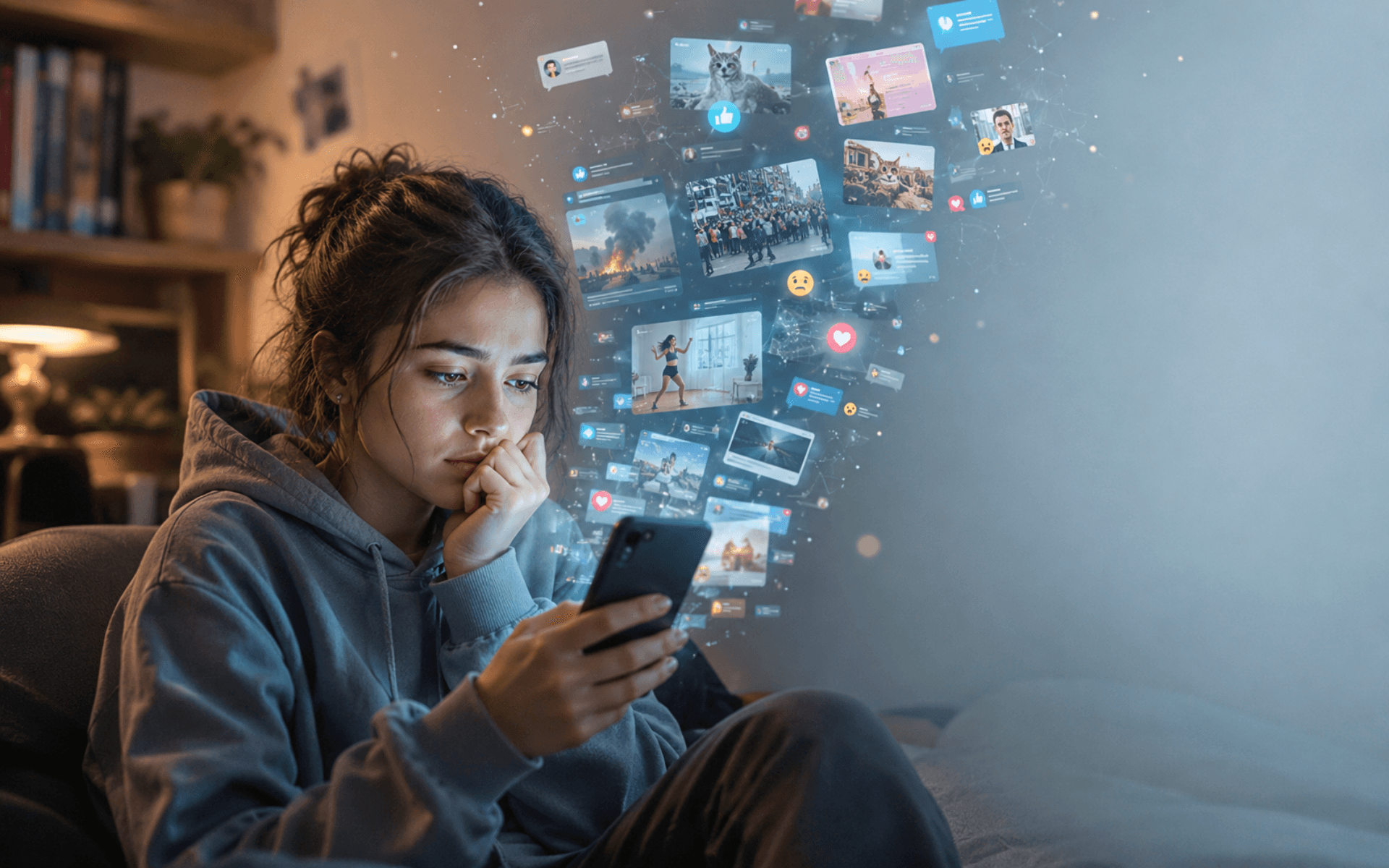
In the information landscape of Generation Z, current events remain a constant presence, though they are intertwined with entertainment, social conversation, advertising, and automated recommendations. That is the fundamental shift: staying informed no longer depends solely on searching for a news story, but on recognizing what appears, why it appears, and where it fits in among everything else.
Three out of every four people share information on social media
The data supporting the paradox appears in the international study Paradoxes in Generation Z’s Media Consumption and Fake News Perception, published in Comunicação e Sociedade and authored by Ana Pérez-Escoda, a researcher at the Francisco de Vitoria University, along with Cristina Ruiz-Poveda of the Complutense University of Madrid. The study analyzes the news consumption habits of 405 college students from Spain, the United States, and Portugal.
The results show that 75% of the students surveyed get their news from social media. Next are websites, at 64%; online news outlets, at 47%; and television, at 37%. Radio, print media, and online television play a much smaller role in their news consumption.
This finding aligns with everyday experience: news appears in the same space where memes, songs, short videos, and algorithm-driven recommendations circulate. According to the study, young people primarily consume leisure and entertainment content, humor, memes, music, and news. News shares the screen.
Trust Turned Upside Down
The most striking finding emerges when we examine the intersection of usage and credibility. The most frequently used sources of information (redes sociales y webs) are also among the least reliable for the young people surveyed. In contrast, traditional media—which account for less time in their daily consumption—are viewed with greater trust.
The findings debunk a rather simplistic notion: that of a youth fully devoted to the digital world. Young people turn to social media because it’s fast, accessible, and relatable, but they view it with suspicion. They seek information when they have doubts.
The sample consists of college students, and its results should be interpreted with that in mind. Even so, the study offers valuable insight for the media, families, and educators: the challenge seems to lie in the ability to prioritize, contextualize, and assess the reliability of information within a continuous stream of content.
The Blind Spot: Fake News
The paradox becomes even more complex when misinformation comes into play. In the international study, three out of ten young people say they never encounter fake news, another three out of ten say they almost never encounter it, and only two out of ten admit to encountering it often or always.
The study suggests two possible interpretations. It may be that initiatives to combat misinformation are working. It may also be that some young people overestimate their ability to recognize a hoax. In both cases, the practical implication points in the same direction: we need more media literacy in college and in public discourse.
This blind spot also appears before college. In the study Practices and Awareness of Disinformation for a Sustainable Education in European Secondary Education, Pérez-Escoda and Manuel Carabias-Herrero analyzed 1,186 minors aged 12 to 17 and 166 teachers.
Almost everyone is familiar with the concept of fake news, but fact-checking strategies are on the decline: 56% of teachers and 43.7% of students use them. In addition, three out of ten in both groups admit that they may have shared fake news without realizing it. Misinformation also spreads by mistake.
The Algorithm as a Gatekeeper
There is a silent player in this mix: the algorithm. The study Taking on Social Media as New Gatekeepers among Young People, in which Pérez-Escoda and Luis Miguel Pedrero-Esteban participate, describes social media as the new gatekeepers of information: filters that decide which content gains visibility.
For decades, that role fell to media outlets, publishers, and journalists. Now, platforms, creators, influencers, personal connections, and viral dynamics also play a part. The filter no longer always looks like a filter: it can be an automated recommendation, a trend, a short video, or a post shared by someone close to you.
The study, conducted with 508 college students from Spain, Colombia, and Costa Rica, reveals very similar patterns across countries. Social media has become a central hub for youth information, while traditional media has taken a back seat. People no longer always seek out the news—it just appears.
Learning to Doubt Wisely
The solution proposed by these studies begins right where the problem arises: social media. For Pérez-Escoda, media literacy must take place in the environments where young people already spend their time. That means teaching them to distinguish facts from opinions, verify sources, recognize persuasive formats, understand why content goes viral, and recognize when an emotion drives them to share before thinking.
That is also the focus of the European project WISE-ME, which centers on the use of social media to address fake news and disinformation in the classroom. In the study Enhancing Teachers’ Digital Competence for Combating Disinformation and Fake News Through the Use of Social Media in the Classroom, the team proposes materials for teachers to develop these skills in middle school based on students’ real-world experiences.
A task for the media as well
This challenge hits the media squarely. A portion of Generation Z no longer gets its news from magazine covers, newsletters, or TV newscasts. It comes in snippets, videos, third-party voices, and recommendations. Regaining their trust requires understanding these pathways and adapting formats without losing rigour.
It also forces us to pay closer attention to their habits. Many young people perceive traditional media as more reliable, but out of step with the way they consume information. That gap leaves room for other intermediaries—sometimes more accessible, sometimes less transparent.
Research in this area shows that we have a generation that is constantly connected and needs better guides to avoid misinformation and its consequences.
If news circulates amid memes, videos, hoaxes, and algorithms, learning to interpret that digital ecosystem can make the difference between passively consuming content and thoughtfully participating in public discourse. Generation Z is already part of that world; the challenge now is to give them better tools to navigate it.