





EXPANDED REASON CONFERENCES 2022:
HUMAN BEINGS IN CONTEMPORARY SCIENCE
CONFERENCE HUMAN BEINGS IN CONTEMPORARY SCIENCE
The 5th Expanded Reason Conference, titled “Human Beings in Contemporary Science,” held on 23 and 24 May 2022 at the Universidad Francisco de Vitoria, embraced a dual purpose: firstly, to showcase some of the best work and researchers of our time, several of them winners of the latest editions of the Expanded Reason Awards. These speakers will show us the paths being taken in biology, biotechnology, physics, ecology, neuroscience and education to make science more humane. Secondly, the conference also looks to deepen a view of reality that places science on the path of respect and service to man and the world.
In short, we ask ourselves, together with experts, what are the challenges, opportunities and difficulties presented by the different fields of contemporary science in relation to the dignity of the person and the care of their environment? The question is rooted in an awareness that scientific advances will be fruitful provided they are at the service of the growth and development of human beings and society and the communities in which they live.
This is custom heading element
María Lacalle, director of the Expanded Reason Institute, had the honor of opening this the fifth edition of the Conference, under the title “The Human Being in Contemporary Science”. During her address, she highlighted the great responsibility in today’s world to make science more humane and to work towards unity of knowledge without skirting the difficulties encountered. She also referenced Pope John Paul II’s for study of serious contemporary problems such as human dignity, the promotion of justice, the protection of nature, the search for peace and a new economic order that better serves the community. Research, in her opinion, should be directed at the root of the problems by seeking creative solutions.
EXPANDED REASON INSTITUTE
UNIVERSIDAD FRANCISCO DE VITORIA
Opening hours: Monday to Friday from 9:00 a.m. to 6:00 p.m
CONTACT THE EXPANDED REASON INSTITUTE
Fill in the form and we will contact you as soon as possible
ROUND TABLES
EDUCATION: A PATH TO MEANING
The first round table entitled “Education: A Path to Meaning” focused on reflection on integral education. The focus of the discussion, led by John Slattery, Curtis Baxter, James Arthur, Verónica Fernández and chaired by Antonio Sastre, was education in the broadest sense, going beyond mere instruction and transmission of knowledge, encompassing the mentorship and support of the student on the path to fulfillment, developing all its dimensions to achieve happiness. An education, therefore, geared towards asking ultimate questions that affect the core of existence, because, although there may seem to be indifference in the classrooms, in the heart of every student there is a longing for answers.
ARE WE PHYSICALLY AND PSYCHOLOGICALLY DETERMINED? NEUROSCIENCE AND PSYCHOLOGY IN DIALOGUE
The third round table was held under the title “Are we physically and psychologically determined? Neuroscience and Psychology in Dialogue”.. To answer the question as to whether the human being is physically and psychologically determined, Paul Vitz presented a Catholic Christian metamodel in which he defends free will from three points of view: the way in which life can be known (experience of conscience), the choice of the therapeutic process to develop the virtues, and the spiritual life it entails (soul capable of choosing god).
Therese Lysaught, along with her fellow researchers, has discovered where the idea that neuroscience is determined comes from. They identified a correlation between economics and virtue, since if there was prosperity, it came from being virtuous, so that a whole cultural anthropology was rooted in the most recent version of the homo economicus. They also found that there was a case of biological determinism, based on medication and the reduction of psychological problems to a genetic issue, which departs from the person-centered model and neglects the social context. For this reason, she has encouraged the creation of open spaces that address pertinent questions and establish an interdisciplinary dialogue.
BIOLOGY AND BIOTECHNOLOGY AT THE SERVICE OF THE HUMAN QUESTION
EXPANDED REASON AWARDS CEREMONY
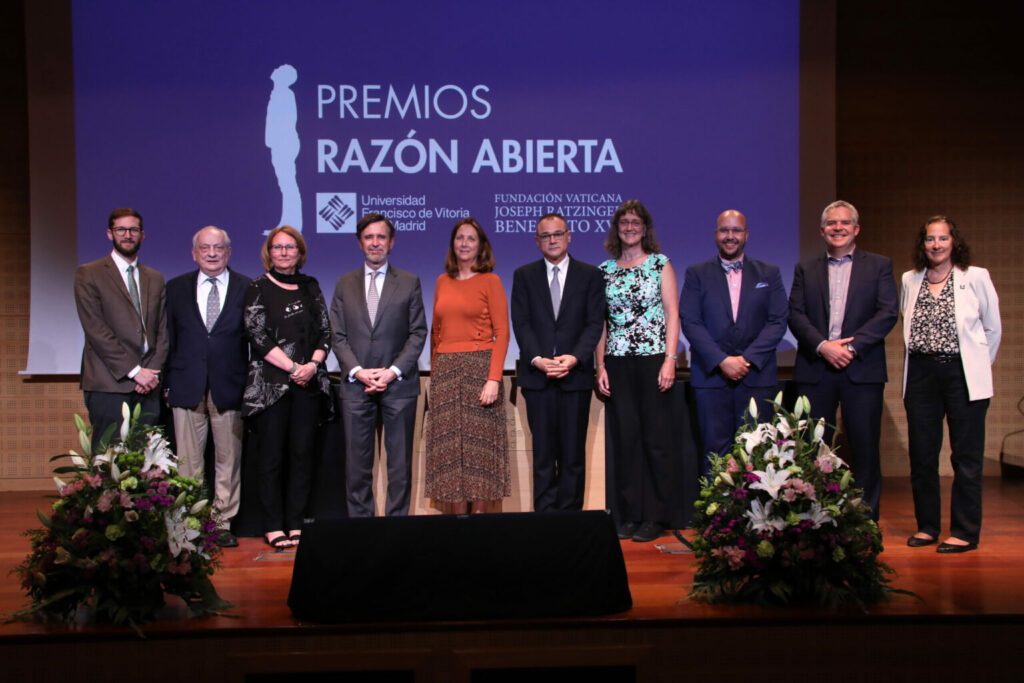
The Awards Ceremony, which concluded the Expanded Reason Conferences, brought together the winners of the 4th and 5th editions who, due to the COVID-19 pandemic, were unable to receive their awards in previous years.
The Vice-Chancellor of the Universidad Francisco de Vitoria, Daniel Sada, and the executive secretary of the Joseph Ratzinger-Benedict XVI Vatican Foundation, Pierluca Azzaro, gave welcoming remarks congratulating the winners and highlighting the importance of the mission of the Expanded Reason Awards in the university world as a service to society.
The winners of both editions took to the stage to receive their awards and thanked their home universities and institutions and their colleagues on their working teams. All emphasized that the fruit of their work would not have been possible without their teams and wider communities.
THE WINNERS AND THEIR WORKS
The Awards Ceremony, which concluded the Expanded Reason Conferences, brought together the winners of the 4th and 5th editions who, due to the COVID-19 pandemic, were unable to receive their awards in previous years.
The Vice-Chancellor of the Universidad Francisco de Vitoria, Daniel Sada, and the executive secretary of the Joseph Ratzinger-Benedict XVI Vatican Foundation, Pierluca Azzaro, gave welcoming remarks congratulating the winners and highlighting the importance of the mission of the Expanded Reason Awards in the university world as a service to society.
The winners of both editions took to the stage to receive their awards and thanked their home universities and institutions and their colleagues on their working teams. All emphasized that the fruit of their work would not have been possible without their teams and wider communities.
4TH EDITION
Teaching Character Virtues – A Neo-Aristotelian Approach
James A. Arthur (University of Birmingham).
Catholic Christian Meta-Model of the Person: Integration of Psychology and Mental Health Practice
Paul C. Vitz, William J. Nordling and Craig Steven Titus (Divine Mercy University).
Human Embryos. Human Beings. A Scientific and Philosophical Approach
Samuel B. Condic (University of St. Thomas, Houston) and Maureen L. Condic (University of Utah).
What’s the matter? Toward a neo-Aristotelian ontology of nature
William M. R. Simpson (University of Cambridge).
5TH EDITION
John Slattery, Curtis L. Baxter, Katharine Hinman and Jennifer J. Wiseman (American Association for the Advancement of Science).
What it means to be human: the case for the body in public bioethics
Carter Snead (University of Notre Dame).
Biopolitics after neuroscience: morality and the economy of virtue
Jeffrey Bishop (Saint Louis University / Albert Gnaegi Center for Health Care Ethics), Andrew Michel (Vanderbilt University School of Medicine) y Therese Lysaught (Loyola University Chicago).
The foundations of nature: metaphysics of gift for an integral ecological ethic
Michael Dominic Taylor (Edith Stein Philosophy Institute / International Laudato Si´Institute). Mención de Honor
Christopher Kaczor (Loyola Marymount University).