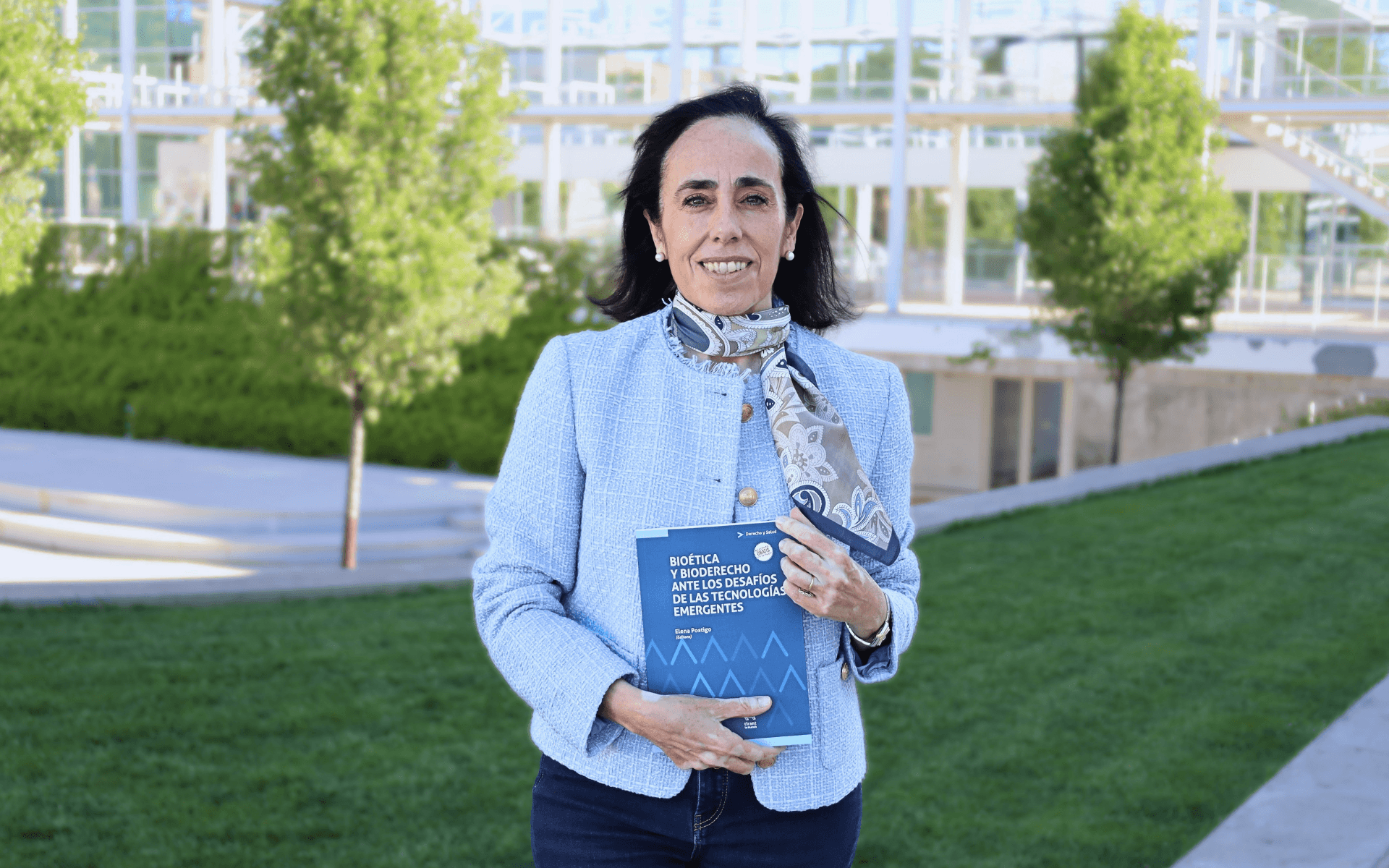
Elena Postigo, director of the Institute of Bioethics at Universidad Francisco de Vitoria, poses with the book “Bioética y bioderecho ante los desafíos de las tecnologías emergentes” (Bioethics and Biolaw in the Face of the Challenges of Emerging Technologies), a collective work reflecting on the bioethical and legal challenges posed by the new science.
Editing genes, intervening in the brain or anticipating diseases no longer belongs to science fiction. These are possibilities that are beginning to make their way into laboratories and doctors’ offices.
And with that transformative power comes an increasingly urgent question: how far is it ethically advisable to go? Against that backdrop, Elena Postigo puts forward a clear idea: “The challenge is not to hold technology back, but to steer it so that it never loses sight of the person.”
A doctor in Bioethics and Philosophy, professor, researcher and director of the Institute of Bioethics at the UFV, Postigo has just coordinated Bioética y bioderecho ante los desafíos de las tecnologías emergentes. The book brings together specialists from different fields to examine some of the most decisive debates of our time and to answer an underlying question: how can science advance without forgetting what it is for and whom it should protect?
Years spent thinking about what is now already here
Elena Postigo’s concern with these questions is not new. She has devoted more than two decades to bioethics and pinpoints a key moment in 2007, during a postdoctoral stay at the University of Oxford. There she came to know the debate on transhumanism at first hand and made contact with authors such as Nick Bostrom, Anders Sandberg and Julian Savulescu, then linked to some of the leading research centres on the future of humanity and applied ethics.
That period changed the kind of questions that guided her work. It was no longer enough to ask what science can do. “We also had to think about what idea of the human being lies behind certain advances and what consequences may follow from embracing it without critical reflection.”
That path helps explain why this book arrives now. Many questions that seemed theoretical a few years ago have begun to take real shape.
Gene editing, the prospect of human enhancement, intervention in the brain and the convergence between artificial intelligence and neuroscience no longer belong solely to the realm of speculation. They have moved squarely into laboratories, hospitals and legal debates.
A new landscape for science
Postigo locates much of this change in the so-called NBIC technologies: nanotechnology, biotechnology, artificial intelligence and the cognitive sciences. What is decisive, she notes, is not only that each advances separately, but that they are beginning to intersect and to open up a new landscape for science.
 The convergence between biotechnology, artificial intelligence and neuroscience is opening up new possibilities for research and medicine, while also raising major ethical challenges.
That intersection multiplies what can be done today. Genetics converges with artificial intelligence to detect certain diseases earlier, anticipate risks and fine-tune treatments. Neuroscience draws on new tools able to record and translate brain activity. “Science thus moves into ever more delicate areas of human life, such as consciousness, privacy and freedom,” she explains.
All of this opens up highly valuable possibilities. It makes it possible to diagnose earlier, treat better and support complex situations with greater precision. But it also forces us to ask new questions.
Above all, when the intervention affects very early stages of life or brain processes whose effects are not yet fully understood. There, Postigo argues, admiring the advance is not enough. “We need to think about how it may affect human life and fundamental dimensions of the person.”
Bioethics as a compass
One of the central ideas of the interview she gave to the UFV Vice-Rectorate for Research is her rejection of the image of bioethics as an obstacle or a containment wall.
For a long time, she explains, “ethics has been understood as something that comes at the end to set limits or to hold back what science wants to do.” Her approach is very different.
For Postigo, bioethics must be part of scientific work itself. Ethics, she maintains, must also guide the researcher’s conduct. It should not turn up once everything is already under way. It has to accompany research from within. Not as a morality imposed from outside, because that would be moralism, but as a way of thinking more carefully about what is done, why it is done and whom it may affect.
That is also the vision she tries to convey to her students. The point is not for the scientist to face an external correction once the process is over, but to be able to “think ethically from within their own scientific and technological work and to direct it to the service of the person and the common good,” the expert stresses.
That perspective shifts the focus. The question, she insists, is not fear of technology. It is the responsibility with which it is used. Those who do research today work with tools of extraordinary power. That is why they must ask about the good they are pursuing, the harm they might cause and the meaning of their work. Seen in this light, bioethics does not weaken science. It gives it depth, direction and judgement.
Postigo offers a clear example. Gene editing for therapeutic purposes using CRISPR/Cas9 may open up valuable medical applications. But intervening in the somatic line is not the same as intervening in the germline or the embryo.
In this second case, she explains, the consequences may be unpredictable and gravely affect the integrity of the human being. There, the reflection is first scientific, because it requires weighing real risks, and also ethical, because it must guide the course of the research.
When technology enters the mind and mental privacy
Few issues illustrate this shift as clearly as neurotechnology. The possibility of intervening in the human brain has advanced greatly in recent years. There are already applications of great therapeutic value, especially in neurological diseases or in cases of severe disability.
Postigo points to brain-computer interfaces as one of the clearest examples. These technologies can help someone who has lost the ability to speak to communicate through a device. The potential is enormous and opens up hopeful paths for many people.
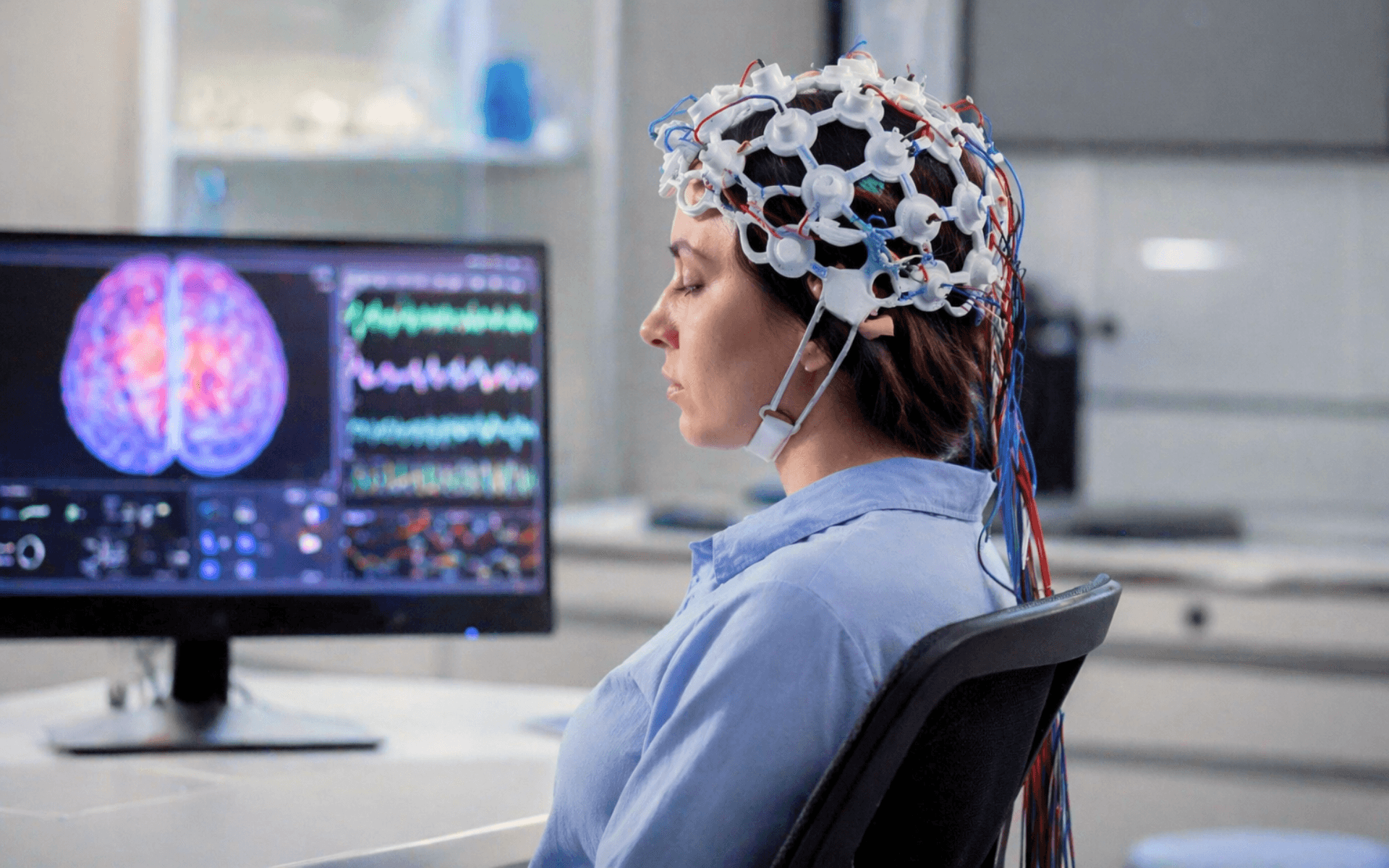
The development of brain-computer interfaces illustrates the potential of neurotechnology and the new challenges it poses for the privacy and freedom of the person.
But that same advance raises a far-reaching question: how to protect mental privacy and freedom when a machine gains access to brain data. This is where one of the book’s central themes appears: the debate over neurorights.
Postigo explains that it is not so much a matter of inventing entirely new rights as of rigorously applying rights that are already fundamental — such as privacy, freedom and intimacy — to a setting that until recently did not even exist.
In her view, that is one of the great challenges of neurotechnology: enhancing its therapeutic benefits without leaving the person unprotected in the most intimate sphere of their mental life.
Dignity as the criterion
That, ultimately, is the thread that runs through the whole work: “the need to protect the person and, in a special way, the most vulnerable.” Postigo insists that the bioethics she defends is centred on basic goods such as the dignity of the person, respect for their integrity, privacy and freedom.
That attention reaches those in situations of particular fragility: people who are ill, people with disabilities, dependent people, and also those at the earliest stages of life. In all these cases, she maintains, science must move forward with prudence and with a very clear idea of what deserves to be protected.
That responsibility also extends to future generations. Some interventions, especially in the genetic field, can have irreversible effects and reach far beyond the present. That is why it is not enough to look at the immediate benefit. We must also think about consequences that today we still cannot fully foresee.
A collaborative book for a shared challenge
The book she has coordinated, Bioética y bioderecho ante los desafíos de las tecnologías emergentes, published by Editorial Tirant Lo Blanch, was born of that need to look at the problem from different angles.
Postigo has brought together scientists, doctors, jurists, philosophers, theologians and neuroscience specialists, convinced that no single field can, on its own, respond to challenges of this magnitude.
The work ranges over subjects such as gene editing, neurotechnologies and the new challenges of biolaw. But its value lies not only in bringing together topical issues. It lies in offering a framework to think them through seriously, without alarmism and without naivety, and without losing sight of the fact that behind every technical advance there is always a human question.
Here, too, lies one of Elena Postigo’s clearest contributions: a reminder that “technology does not determine its own meaning on its own. What matters is still how it is used and what it is used for.”
At a time marked by fascination with everything that is now possible, her reflection introduces a more demanding question: not only what we can do, but what it is worth doing, so that scientific and technological development contributes to a truly human progress.