






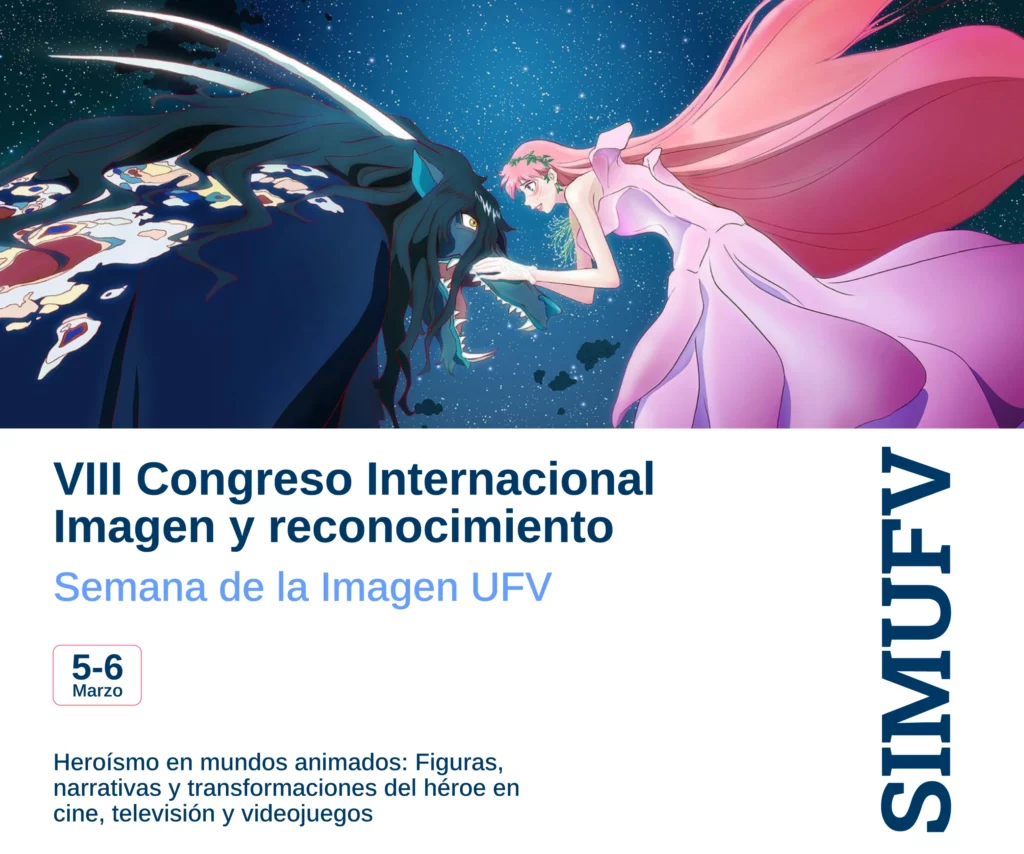
VIII INTERNATIONAL CONGRESS IMAGE AND RECOGNITION - Heroism in Animated Worlds
The 7th International Congress on Image and Recognition, part of the Image Week of the Universidad Francisco de Vitoria (SIMUFV 2026) brings together professionals, academics and students to reflect on the contemporary image in dialogue with humanities. On this occasion, the congress is entitled “Heroism in Animated Worlds” and will take place from March 5 to 7, 2026 at the Universidad Francisco de Vitoria (Pozuelo de Alarcón, Madrid).
In recent decades, animated worlds -in their multiple audiovisual and digital manifestations- have become consolidated as narrative spaces of high symbolic density, capable of renewing heroic figures without breaking with the traditions that sustain them. From classic heroines (Nausicaä of the Valley of the Wind, 1984; Mulan, 1998) to contemporary antiheroes (BoJack Horseman, 2014-2020), animation, both in film and in television and video games, has proven to be a privileged laboratory for experimenting with archetypes, trajectories and dilemmas of heroism.
These worlds allow to imagine the impossible from universes that defy the logics of realism (Spider-Man: Across the Spider-Verse, 2023), but also to explore forms of heroism in scenarios closer to lived experience (Waltz with Bashir, 2008) or in liminal thresholds between reality and fantasy (La Tortue rouge, 2016).
The VIII International Congress Image and Recognition, entitled “Heroism in animated worlds: Figures, narratives and transformations of the hero in film, television and video games”, is proposed as a critical and multidisciplinary space to reflect on the metamorphosis of the hero in contexts of animation and virtuality. It is aimed at researchers in Film and Media History, Animation Studies, Audiovisual Narrative, Narratology, Comparative Literature, Aesthetics, Philosophy and Theology, as well as professionals in the field of animation and video games.
This congress seeks, more generally, to offer a humanistic and transdisciplinary look that explores the expressive power of the contemporary image as a way for the recognition of the human.
Thematic areas and methodologies
- Genealogies, archetypes and transformations of heroic figures and their worlds. Research on the historical evolution of the hero and his world in cinematographic, television or digital animation. Studies on classical archetypes (the knight, the heroine savior, the trickster) and speculative worlds (utopias, dystopias, fantasy), as well as their transformations, hybridizations or contemporary parodies are welcomed. The line contemplates comparative, mythological, cultural or philosophical approaches.
- Problematic heroism: antiheroes, vulnerability and animation for adults. Dedicated to the study of dissident, cynical or fragile heroic figures and the consistency of these characteristics in relation to their world. Contributions from narratology, moral psychology, cultural studies or critical aesthetics are valued.
- Visual aesthetics and design of the animated hero. It explores the ways in which heroism is visually constructed in animation. Covers everything from concept art and character modeling to the distinctive visual styles of animated works. Analysis of transitions between media (manga-anime, comic-animation), aesthetic adaptations and creative processes in the industry. Study of how the visual environment conditions or reflects the heroic figure.
- Video games, interaction and transmedia narratives. Analyzes heroic forms in video games and transmedia narrative universes. It considers proposals on the playable hero (avatar), the ethics of interactive control, persistent worlds and multiplatform franchises, and industrial and cultural studies on the logic of IPs and their narrative strategies.
- Animated possible worlds and television seriality formats. This line includes studies on the construction of fictional universes in animated series and their relationship with television narrative formats. Proposals that analyze how seriality configures the figure of the animated hero, as well as his evolution, agency or ethical tension will be valued. Research on persistent worlds, complex temporal structures and the role of television in the consolidation of heroic archetypes in animated contexts will also be included.
- Image and recognition (permanent line of the congress). Open to research that analyzes the expressive power of the animated image as a way for the recognition of the human, from hermeneutic, philosophical, anthropological or theological perspectives. This transversal line welcomes works that link heroic figure, visual poetics and experience of meaning in cinema, fiction series, video games and other arts.
Priority will be given to research that seeks an interdisciplinary dialogue between thematic areas and the humanities, especially insofar as the objects studied are presented to us as significant images in which to recognize our world and our way of inhabiting it.
Suggested methodologies
Theoretical or conceptualization studies. Approaches that develop analytical frameworks or critical categories applicable to the understanding of heroism, animation or the figure of the hero in audiovisual contexts.
Hermeneutic practices on poetic possible worlds. Philosophical, symbolic or mythopoetic interpretations that delve into the structure of meaning of animated narrative worlds.
Textual, aesthetic or close-reading analysis. Detailed study of specific works through filmic, narratological, visual or rhetorical analysis tools.
Case studies. Research focused on a specific text, author, character or phenomenon to illustrate broader processes.
Intermedial and transmedia analysis. Methods that explore the circulation of heroic stories between different media (cinema, television, video games, comics, social networks) and their resignification according to the format or channel.
Studies of reception and experience of the spectator or player. Empirical or phenomenological approaches to the way in which audiences relate to animated heroic figures, especially in video games or interactive environments.
Genealogy and ideological criticism. Methods derived from critical philosophy, conceptual history, or cultural studies that trace the ideological, political, or theological assumptions of heroic narratives.
Analysis of cultural imaginaries and archetypes. Symbolic or comparative approaches that connect animated characters to cultural, mythological, or religious traditions.
Production and industry studies. Research on processes of creation, circulation and legitimization of animated works, including the study of character design, animation studios or franchise logics.
Perspectives of comparative aesthetics or phenomenology of the image. Philosophical approaches that study the viewer’s sensitive experience of the animated image and its capacity to summon forms of symbolic recognition.
This congress accepts proposals for oral communications and academic video-essay proposals. Only proposals that meet the deadlines and formal requirements indicated in this call will be accepted. Authors are encouraged to review in detail the registration section and calendar in this call and to confirm it in the SIMUFV web page in case there are any updates.
The scientific committee, with a view to the subsequent publication of the results of the congress, will pay special attention to the following criteria:
- The relevance of the contribution in relation to the theme of the congress, with special emphasis on one of the six thematic areas.
- The scientific quality of the proposals and their possible impact on the training of communication professionals or on the professional flows of audiovisual production.
- The originality and novelty of the proposal.
At the end of the congress, the presenters will be eligible for the publication of their communication and the review of their video-essay in a monographic volume of the collection “Jano Comunicación y Humanidades” of Editorial Sindéresis, recognized with the SPI quality seal for specialized publications in Humanities and Social Sciences.
A book of abstracts will also be published in digital format by Editorial UFV with the corresponding digital ISBN.
Modalities of presentation
A. Oral communication
Authors are requested to send their oral communication proposals by means of a form on the conference website with the following data:
– Name and SURNAME.
– DNI.
– E-mail.
– ORCID number (if available).
– Affiliation (if any).
– A postal address, in case it is necessary to send certificates or publications.
– An abstract in Spanish, Portuguese, Italian or English of between 400-500 words, including: problem statement, purpose, methodology, results and expected conclusions. Care should be taken in the wording for publication in the book of abstracts.
– A list (three to five) of the sources to be used in Chicago format.
– A brief CV of 100-150 words.
B. Video-essay communication
Authors are requested to send their video-essay proposals by means of a form on the conference website with the following data:
– Name and SURNAME.
– DNI.
– E-mail.
– ORCID number (if available).
– Affiliation (if any).
– A mailing address, in case it is necessary to send certificates or publications.
– A presentation of the video with a length between 400-500 words, in Spanish, Portuguese or English.
– A brief list of sources used.
– A brief CV of 100-150 words.
The video-essays replace the physical attendance and should be thematically adjusted to the areas proposed in the call for papers. They can be in any language, always with English subtitles. Their duration should be around 10 minutes and never exceed 15 minutes. The video-essay must be hosted on the Google platform, with private access. It must include, in the first images, the author’s name, the title of the video-essay, as well as the name, the date, the title of the congress and its logo.
The reception of paper and video-essay proposals ends on January 18, 2026 at midnight; the registration to the congress can be done once the paper or video-essay is accepted by the scientific committee and always before February 2, 2026. The deadline for sending the URL with the final video-essay and the password to access it is February 15, 2026.
Registration entitles you to:
- If this is the case, to receive certificates of participation in the conference and of acceptance and presentation of the oral communication or video essay, following a blind peer review carried out by the scientific committee of the conference.
- If this is the case, please submit the paper or a summary of the video essay in writing for possible publication, following a new review and acceptance process by the scientific committee, in the book that will compile the results of the conference, published by Editorial Sindéresis in the collection “Jano Comunicación y Humanidades”.
Once the scientific committee has accepted the proposal for a paper or video essay, registration and payment of fees can be formalized using the appropriate forms, depending on whether the paper is by a postgraduate student (€20,00) or PhD (€30,00), always before February 2, 2026. It is also possible to register as participating audience with certificate of attendance.
ANTES DEL 31.01.2026
DESDE EL 31.01.2026
GRUPO
70€
100€
Asistencia. Público que no participa con comunicación o vídeo-ensayo, pero desea certificado de asistencia.
30€
60€
Comunicadores. Doctores cuya propuesta de comunicación o presentación de vídeo-ensayo ha sido aprobada por el comité científico.
20€
40€
Estudiantes de grado o postgrado cuya propuesta de comunicación o presentación de vídeo-ensayo ha sido aprobada por el comité científico.
Sin coste, hasta completar aforo. Se requiere inscripción.
Sin coste, hasta completar aforo. Se requiere inscripción.
Público que desea asistir sin recibir certificado.
ANTES DEL 31.01.2026 | DESDE EL 31.01.2026 | GRUPO |
70€ | 100€ | Asistencia. Público que no participa con comunicación o vídeo-ensayo, pero desea certificado de asistencia. |
30€ | 60€ | Comunicadores. Doctores cuya propuesta de comunicación o presentación de vídeo-ensayo ha sido aprobada por el comité científico. |
20€ | 40€ | Estudiantes de grado o postgrado cuya propuesta de comunicación o presentación de vídeo-ensayo ha sido aprobada por el comité científico. |
Sin coste, hasta completar aforo. Se requiere inscripción. | Sin coste, hasta completar aforo. Se requiere inscripción. | Público que desea asistir sin recibir certificado. |
REGISTRATION PERIOD CLOSED
August 2025S – Publication of the call for papers / call for papers From this moment on the scientific committee will receive the communication proposals and video-essay presentations and will assess whether they meet the formal and thematic criteria of the congress. If they do not, the author of the proposal will be informed. In the affirmative case, a blind peer review process will be initiated, the result of which, accompanied by a report, will be communicated to the author within a maximum of one month.
January 18, 2026 – – Deadline for submission of communication and video-essay proposals.
January 30, 2026 – – Deadline for responding to the latest proposals for communication.
February 2, 2026 – – Deadline for registration and payment for the conference.
February 15, 2026 – Deadline for submitting video essays.
March 5–6, 2026 – Congress celebration.
March 17, 2026 – Once the conference has ended and the presentations and video essays have been evaluated, the scientific committee will invite some speakers to develop their presentations into chapters for a scientific book.
May 18, 2026 – The deadline for submitting book chapters has passed. The scientific committee has begun evaluating the contributions and editing the publication.
July 1, 2026 – The project is delivered to the publisher for layout and evaluation of the entire work.
November 2026 – Publication of the book
WEDNESDAY 4 – PRE-CONGRESS
3:30 pm Table 1
Moderated by Ms. Laura Santos
Heroines without permission: Female power in interactive universes
Ms. Irene Cabrera Morales
From player to hero: epic, aspiration and transmedia in the openings of the League of Legends World Championship
Ms. Cristina Montes Pastrana
From storyteller to digital hero: Rites of passage and cultural transmission in immersive virtual reality experiences
Jorge Mula Ferrer
Ms. Marina Sanjuán Sánchez
Isaac en los laberintos de Roussel: el ensamblaje de la literatura y el videojuego a partir de la disolución del protagonista
Juan Serrano Medina
5:30 pm Mesa 2
Moderated by Dr. Minerva Parra Peralbo
From darkness to redemption: villains and antiheroes in animated worlds
Santiago Riquer Masiá
Han, Heung and Heroes: Redemption and Shamanism in K-Pop Demon Hunters
Daniel Panizo Vivancos
Santiago Lascano Santa-Cruz
The hero’s journey as a rhetorical device: the demonstration of logos through dramatic participation
Ignacio Pou Díaz de San Pedro
Typographic weight and the representation of the hero archetype
Ms. Lucía Retamar Pérez
THURSDAY 5 – CONGRESS
10:00 Inaugural lecture – Dr. Antonio Loriguillo López
Beyond the hero shōnen classic: transformation of the protagonist in the manganime contemporary
12:00 Round table: cinema
Moderated by Dr. Ignacio Laguía Cassany
Animated war films in Japan. The naification and heroism in The Grave of the Fireflies (Takahata, 1988) and The Wind Rises (Miyazaki, 2013)
Dr. Ruth Gutiérrez Delgado
Fragility as a form of heroism: implicit soteriology in The Walking Castle
Dr. Juan Serrano Vicente
The white wolf in Japanese anime popular culture: Cultural and formal analysis of Mononoke Hime, Ôkami and Golden Kamuy
Dr. Víctor Navarro-Remesal
Dr. Laura Montero Plata
Dr. Mateo Terrasa Torres
Heroic identity as a humanizing key to the robot in the scripts of The Iron Giant, Big Hero 6 and Robot salvaje
Dr. Antonio Sánchez-Escalonilla
Hope as a transformative virtue in animation: a narrative study of Disney’s new heroines
Dr. Álvaro Iparraguirre-Bernaola
Lunch
15:30 Round table: series
Moderated by Dr. Juan Rubio de Olazabamba.
Constructing identity: Antiheroic adolescent archetypes in Win or Lose (Pixar, 2025)
Dr. Ignacio Laguía Cassany
Time as a vital asset: death, meaning and despair from the case of Death Note
Dr. Jesús Baiget Pons
Between saga and chronicle: the Nordic Middle Ages in an intercultural key in manga and anime Vinland Saga
Dr. Gilberto Fernández Escalante
Frieren according to the master-sage archetype, overcoming the Campbellian model
Dr. Victoria Hernández Ruiz
Dr. Francisco Javier Rubio Hípola
The hero-antihero dilemma in the anime series Dororo (2019)
Dr. Santiago Huvelle
17:30 Round table: animated miscellany
Moderated by Dr. Álvaro Abellán-García Barrio
Snow White as a redeemed heroine in “Berhaim” by Rosalía
Dr. José María Alejos Bermejo
Maus. A survivor’s account: representation of suffering and processing of trauma in the graphic novel
Dr. Antonio Javier García González
The hero without a safety net: self-sufficiency, memory, and recognition in contemporary animated worlds
Dr. Minerva Parra Peralbo
Tricks are (not) for kids. The use of animation sequences for the definition of the (anti)hero in the films of Quentin Tarantino and Wes Anderson
Dr. Rubén de la Prida Caballero
FRIDAY 6
10:00 Round table: video games and series
Moderated by Dr. Victoria Hernández Ruiz
Attention as a heroic virtue: a videogame interpretation by Simone Weil
Dr. Guillermo Gómez-Ferrer Lozano
The hero with 24 faces: from the epic archetype to fragmented heroism in The Legend of Zelda: Majora’s Mask
Dr. Rubén Gregori Bou
MS. Cristina Guzmán Anaya
The sacrifice of the hero in video games: towards a phenomenological hermeneutics of sacrifice in ludopoetic possible worlds
D. Xavier Gutiérrez Aguirre LC
Grief and vulnerability of the animated antihero: aesthetic analysis of Catharsis, the final episode of Cutting along the dotted line
Dr. Jesús Rubio García
From classical heroism to formative heroism: a comparative reading of the Star Trek animated series
Dr. Monique Villen
12:00 Closing lecture – Dr. Julián Larrauri Escudero
Animated short films and the figure of the hero. The case of El gran leopardo
ORGANIZING COMMITTEE
Dr. Diego Botas Leal
Universidad Francisco de Vitoria
Dr. Arturo Encinas Cantalapiedra
Universidad Francisco de Vitoria
SCIENTIFIC COMMITTEE
President
Dr. Arturo Encinas Cantalapiedra
Universidad Francisco de Vitoria
Members
Dr. José Ángel Agejas Esteban (Universidad Francisco de Vitoria)
Dr. Álvaro Abellán-García Barrio (Universidad Francisco de Vitoria)
Dr. Javier Figuero Espadas (Universidad San Pablo CEU)
Dr. Alberto Nahum García Martínez (University of Navarra)
Dr. Guillermo Gómez-Ferrer Lozano (Catholic University of Valencia SVM)
Dr. Ruth Gutiérrez Delgado (University of Navarra)
Dr. Victoria Hernández Ruiz (University Francisco de Vitoria)
Dr. Ignacio Laguía Cassany (University of Navarra)
Dr. Antonio Loriguillo López (Universitat Jaume I)
Dr. Víctor Manuel Navarro Remesal (Tecnocampus – Universitat Pompeu Fabra)
Dr. Catalina Martín Lloris (Catholic University of Valencia SVM)
Dr. Minerva Parra Peralbo (Universidad Francisco de Vitoria)
Dr. Antón Plannells de la Maza (Tecnocampus – Universitat Pompeu Fabra)
Dr. Juan Rubio de Olazábal (Universidad Francisco de Vitoria)
Dr. Antonio Sánchez-Escalonilla (Universidad Rey Juan Carlos)
Dr. Teresa Sorolla Romero (Universitat Jaume I)
PROFESSIONAL MEET UPS
Coming soon
CONTESTS
Coming soon