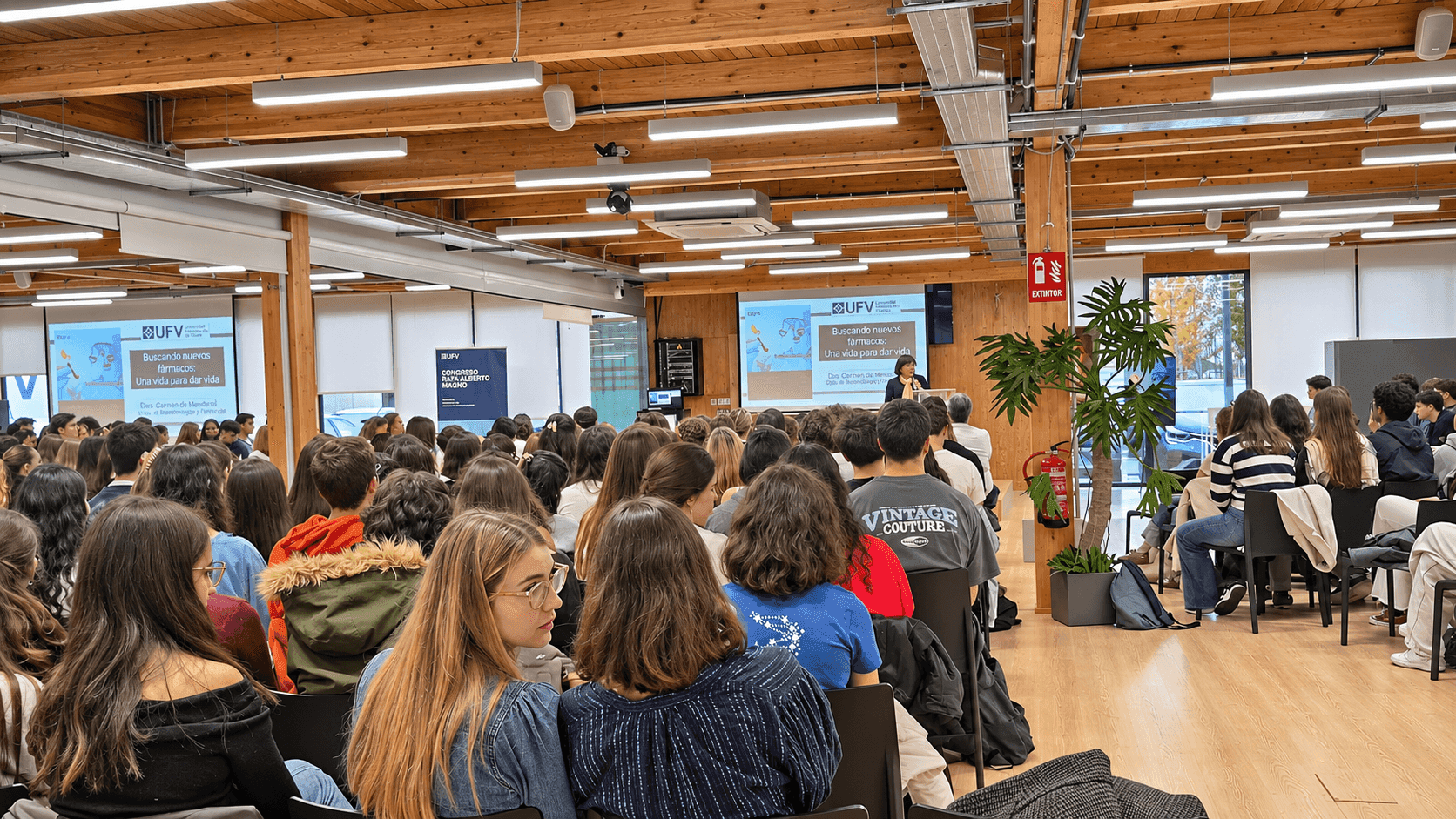
The writer Lorenzo Silva presented this Thursday at the Universidad Francisco de Vitoria (UFV) Reaching Toward the Stars: The Life of Francisco de Vitoria, his new book on the life and thought of Francisco de Vitoria. The book, sponsored by the UFV and published by Ediciones Destino, aims to introduce the general public to the legacy of one of the key figures of the School of Salamanca.
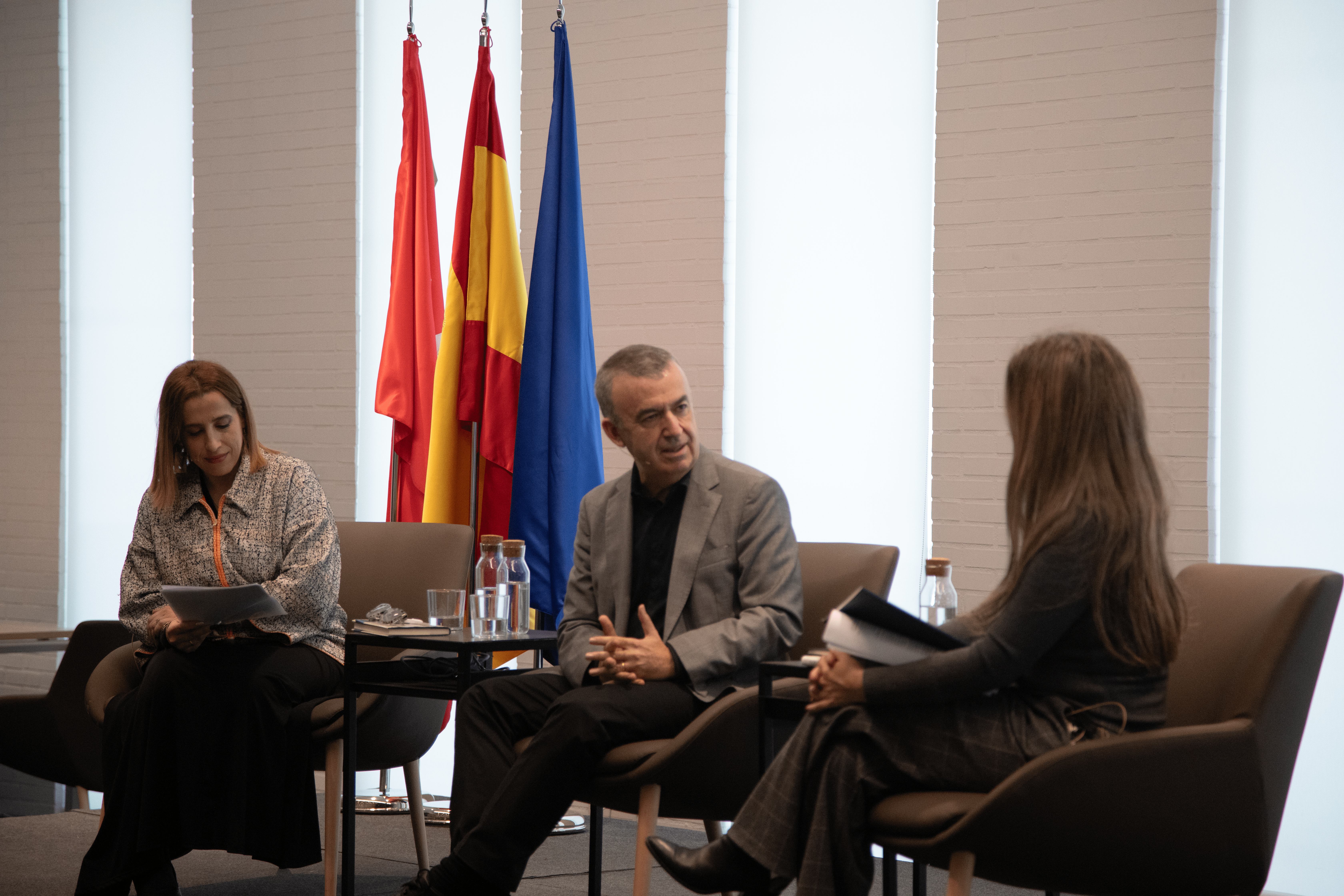
The event took place on the UFV campus in the form of a conversation between Lorenzo Silva and Victoria Hernandez, director of the University’s “ Bachelor's Degree ” in Fiction and Narrative and the “ Bachelor's Degree ” in the Humanities, moderated by Ana María del Valle, dean of the School of Communication Sciences.
The event began with a speech by Daniel Sada, president of Francisco de Vitoria University, who highlighted the opportunity this work presents to delve deeper into the teachings and messages left by Francisco de Vitoria five centuries ago, which continue to challenge the world today.
Next, Ana María del Valle She began the conversation with a question that runs throughout the work itself: “What leads a man of his time to wield not the sword, but the word?” The dean recalled that, while Spain was expanding its dominions across the world, Vitoria helped to expand another realm: “that of thought on justice, the law, human dignity, and the limits of power.”
Rediscovering the Man Behind Francisco de Vitoria
During the conversation with Victoria Hernandez, Lorenzo Silva He has explained the research and writing process that has allowed him to gain insight not only into Vitoria's thought, but also into his more human side, his intellectual calling, and a life devoted to study and teaching.
The author himself explains the purpose of the work as follows: "This book is neither a biography, nor a historical essay, nor a summary of its protagonist’s doctrines, although elements of all three can be found within its pages. It stems from a more modest endeavor: to introduce the thought and figure of Francisco de Vitoria to those unfamiliar with them, without the pretensions of a scholar or expert and using the tools of literary narrative."
To develop that perspective, Lorenzo Silva He has drawn on biographers, scholars of the period, theologians, and Vitoria’s own texts that have survived to this day—some of them thanks to the notes taken by his students. From this exploration emerges, in the author’s words, a man who “knew how to combine erudition, thought, and courage to speak the truths that the powerful did not wish to hear.”
A significant part of the conversation has focused specifically on Francisco de Vitoria's status as a teacher. Lorenzo Silva He has discussed his teaching style and his ability to encourage his students to think for themselves—a legacy that has endured to this day thanks, in large part, to those who listened to, preserved, and passed on his lessons.
A thought that remains relevant five centuries later
The dialogue has also made it possible to address the relevance today of some of the major questions raised by Vitoria in the 16th century: human dignity, the limits of authority, the responsibility of those who exercise power, and coexistence among peoples.
For Lorenzo Silva, revisiting his thought today holds special significance. The writer describes Vitoria as “a Castilian and Spanish humanist who was crucial to the shaping of Western political thought and the ever-unfinished project of a universal human society,” and believes that “in these times of unchecked and abusive power, five centuries after he began teaching in Salamanca, his ideas are more relevant than ever.”
The conversation has linked these issues to some of today's challenges. In his reflection on Vitoria, Lorenzo Silva It is based on a particularly relevant idea: "Power is founded solely on the common good," and, precisely for that reason, it must recognize its limits.
The enduring relevance of Vitoria's thought was also evident in the remarks by Ana María del Valle, who raised the question during the meeting of what responsibility falls on those who think, teach, or write when their era is marked by moral conflicts, and what it is that makes Vitoria’s reflections on human dignity and the limits of authority continue to challenge us.
Knowledge that makes sense when shared
Francisco de Vitoria’s role as a university scholar and teacher has also been a prominent topic of discussion. His life was deeply connected to study, teaching, and the transmission of knowledge.
Lorenzo Silva He defines education as a way to make “knowledge fruitful and fully rewarding—knowledge that only achieves its full meaning when it is shared and put to use by others.” This reflection takes on special relevance at a time marked by easy and rapid access to information and by the development of artificial intelligence.
The conference thus provided an opportunity to view Francisco de Vitoria not only as a key figure in the history of thought, but also as a teacher capable of continuing to pose questions to today’s universities.
Ana María del Valle He concluded the event by noting that “ideas also have a history, but they are not confined to it” and that there are words that transcend the centuries because they continue to help us reflect on “who we are, how we should live together, and what boundaries power should never cross.”
The dean ultimately linked that legacy to the university's mission itself: "Teaching, writing, creating, and thinking are not isolated activities, but ways to shed light on the world we share."