Professor Qian Ming of Zhejiang Gongshang University introduced the university community to the exchange of techniques, designs, and meanings between Asia and Europe through the Kashmiri shawl and the Manila shawl.
Textiles also tell the story of the relationships between cultures. Through their materials, manufacturing techniques, and decorative motifs, it is possible to reconstruct trade routes and discover how certain objects take on new meanings as they travel from one region to another.
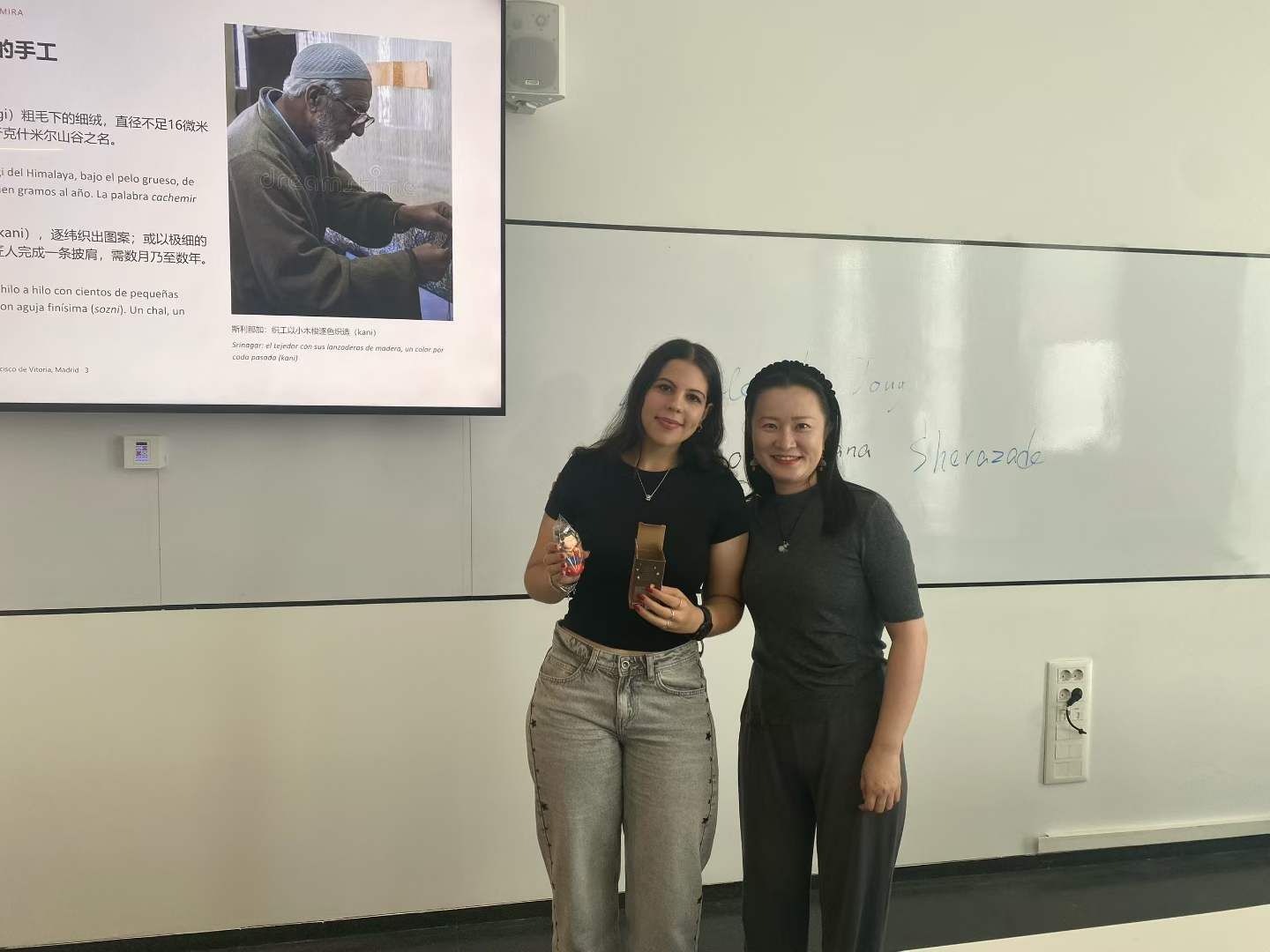
This was the focus of the conference “The Silk Road of Patterns: From the Kashmiri Shawl to the Manila Shawl”, organized on September 24 by the **Society for Asian Studies at the Universidad Francisco de Vitoria (UFV) and presented by Qian Ming, a professor at Zhejiang Gongshang University and a researcher specializing in Kashmiri shawls.
Del chal de Cachemira al mantón de Manila
During the session, Qian Ming demonstrated how two garments illustrate the cultural exchange between Asia and Europe over time. The professor began by explaining the artisanal process of making cashmere shawls and analyzed how some of their decorative motifs were later incorporated into various European contexts.
The lecture also addressed the history of the Manila shawl. Although its name refers to the Philippines, many of these shawls were made in China and reached Spain through Asian trade networks. Once incorporated into the Spanish context, they took on new uses and cultural meanings.
This tour also raised a question related to the very way we interpret historical objects: their names may preserve the memory of the routes they traveled, even if they do not necessarily indicate where they were made.
Los objetos como fuente para comprender las relaciones entre culturas
The session also encouraged participants to view textiles as historical documents. Attendees were able to explore the differences between woven, embroidered, and printed motifs, and to understand how the manufacturing technique itself provides insight into a piece’s origin and evolution.
Through activities such as this, Francisco de Vitoria University fosters interaction between its university community and international researchers and offers new perspectives for understanding the history of relations between cultures. The Society for Asian Studies thus continues to bring knowledge about Asia to the campus through initiatives that connect academic research with specific cultural objects and expressions.