
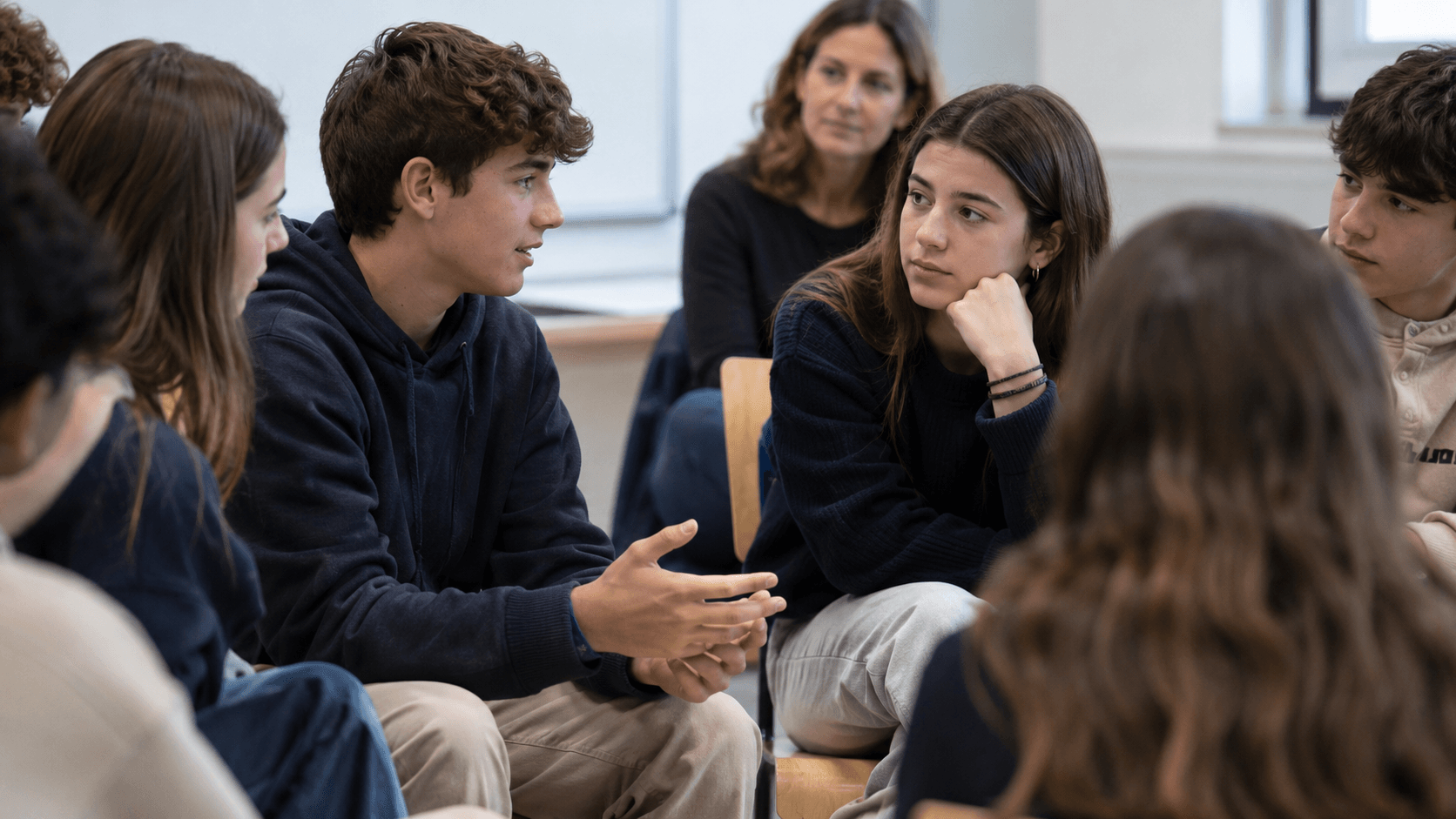
The Institute of Forgiveness from the Universidad Francisco de Vitoria (UFV) is affiliated with the School of Education and Psychology. The institute conducted a workshop on forgiveness for all 2nd-year Compulsory Secondary Education (ESO) students at the San Ignacio de Loyola School in Torrelodones, with the goal of helping them understand its meaning from a psychological perspective and reflect on its importance in personal relationships. The activity took place as part of the international Erasmus+ project Disarm words, disarm the world: peace, forgiveness, and encounter, dedicated to promoting peace and harmony through the dialogue and encounter.
The UFV Institute for Forgiveness conducts research and offers training on forgiveness from a interdisciplinary perspective, with applications in fields such as education. The school’s participation in this project builds on a collaboration that began last school year, when it offered the workshop to a small group of students participating in the Erasmus+ program. Following that initial experience, the school has decided to expand the activity to all 2nd-year ESO classes.
Understanding Forgiveness from a Psychological Perspective
The workshop addressed forgiveness as a psychological process that allows people to cope with the emotional consequences of an offense and that can have beneficial effects for both the person who forgives and the person who is forgiven.
One of its main objectives has been to help students distinguish forgiveness from other responses with which it is often confused, such as forgetting what happened, justifying the harm suffered, or reconciling with the person who caused the offense. This distinction is particularly important for understanding that forgiving does not mean denying the suffering or giving up on setting boundaries in the personal relationships.
To explore these concepts, the workshop leaders have drawn on the testimony of Tim Guénard, whose life story is recounted in the book Stronger Than Hate and in the documentary The Greatest Gift, directed by Juan Manuel Cotelo. Through various scenes, the students reflected on the consequences of painful experiences and the personal journey that can lead to forgiveness.
The session combined an analysis of these testimonials with interactive questions that allowed us to gauge the students’ prior knowledge and delve deeper into the material. During the activity, the students contributed their own reflections, connecting the concepts discussed to conflicts that can arise in personal relationships.
Freedom and empathy, as reflected in the students' thoughts
Student participation has been one of the highlights of the workshop. At the beginning of the session, some students spontaneously linked forgiveness to concepts such as freedom and the empathy. As the event progressed, Tim Guénard’s testimony provided insight into the possibility of forgiveness even after having gone through particularly painful experiences.
One of the final reflections focused precisely on the capacity for forgiveness of a person who has experienced a deep suffering It can help us understand that it is also possible to approach other situations in everyday life through forgiveness.
The activity has made it possible to apply psychological concepts to experiences that are relevant to teenagers, offering them tools for reflection about their emotions and the consequences of their decisions on their relationships with others.
An Erasmus+ Project to Promote Peace and Understanding
The workshop was part of the international conference Dismantling Words, Dismantling the World: Peace, Forgiveness, and Reconciliation, held October 17–24, 2026, at the San Ignacio de Loyola School in Torrelodones, with the participation of students and teachers from the Sacro Cuore Foundation in Milan (Italy).
During that week, the Spanish and Italian students participated in educational experiences and community-building activities designed to encourage reflection on peacebuilding and the value of connecting with others. The project has combined reflection workshops with artistic initiatives and social engagement activities, helping students make connections between these lessons learned from his life everyday.
The international event will continue in Milan between February and March 2027, where the exchange between the two schools. The Institute for Forgiveness’s participation in this initiative makes it possible to apply the psychological knowledge developed in the academic setting to the education of adolescents, helping them understand forgiveness as a human response that can foster harmonious coexistence and help them cope with personal conflicts.


