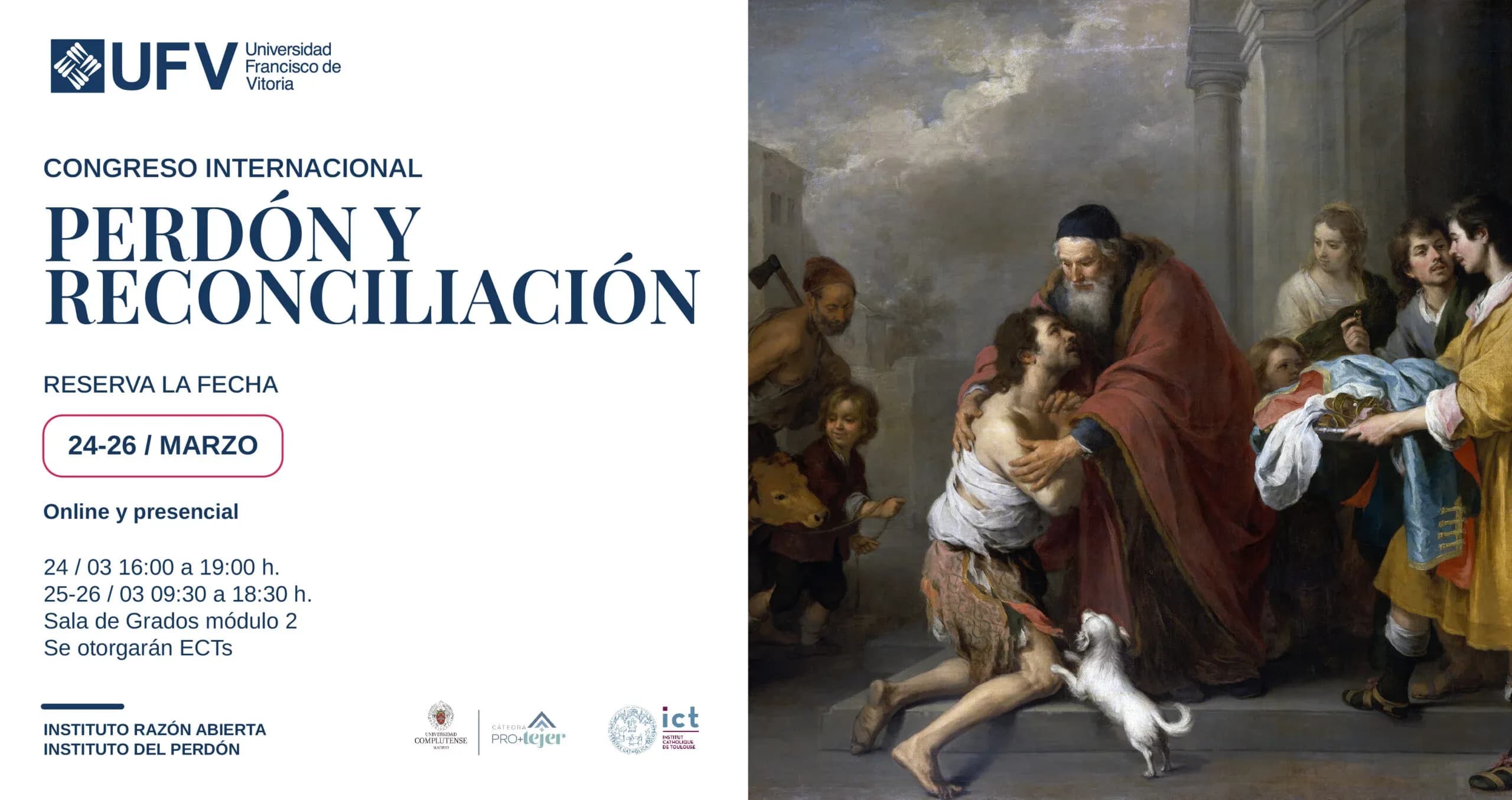
The International Conference on Forgiveness and Reconciliation brings together professionals and scholars from around the world to reflect, from an interdisciplinary, philosophically inspired perspective, on the issues of forgiveness and reconciliation. It will take place from March 24 to 26, 2025 at Francisco de Vitoria University (Pozuelo de Alarcón, Madrid). The conference will be conducted in both English and Spanish, with simultaneous translation provided in both languages. The conference will be held in a hybrid format, allowing participants to attend in person or online.
If the 20th century was marked by shocking acts of violence, the new century—with its accelerated historical pace and societies that are in close proximity to one another and technologically connected—has brought about or definitively exposed other forms of barbarism that undermine social cohesion. Terrorism, health and energy crises, the proliferation of technologies that isolate people, environmental problems, gender-based violence, and abuse… all have the added consequence of creating new forms of social and economic exclusion, as well as mental health conditions and disorders. From an interdisciplinary perspective, it seems increasingly clear that any reflection aimed at shedding light on and offering solutions to these new forms of violence cannot take shape without action—and therefore a study aimed at exploring the possibilities of forgiveness and reconciliation, fundamental associative principles of any society, which enable it to be preserved from disintegration.
Conference venue: Salón de Grados. Central Building. Module 2. Francisco de Vitoria University.
The emergence of a thematic focus on forgiveness in philosophy took place in the second half of the 20th century, and although the literature on the subject is not yet particularly extensive—with contributions coming primarily from Anglo-Saxon thought and, occasionally, from phenomenology—there has been general discussion of a “philosophy of forgiveness” (Lewis –ed.- The philosophy of forgiveness, ed. Lewis, 4 Vols. 2016, 2017). From a broader historical perspective, forgiveness has been the subject of theological studies and has recently attracted the interest of scientific psychology. Sociological reflections—including those aimed at understanding historical phenomena—are becoming increasingly prevalent in contemporary societies.
The "Forgiveness and Reconciliation" Conference aims to provide an interdisciplinary reflection on the meaning, conditions, and scope of forgiveness in human life, across all its cultural dimensions—that is, socio-historical and knowledge-based—with a view to exploring the possibility of reconciliation.